
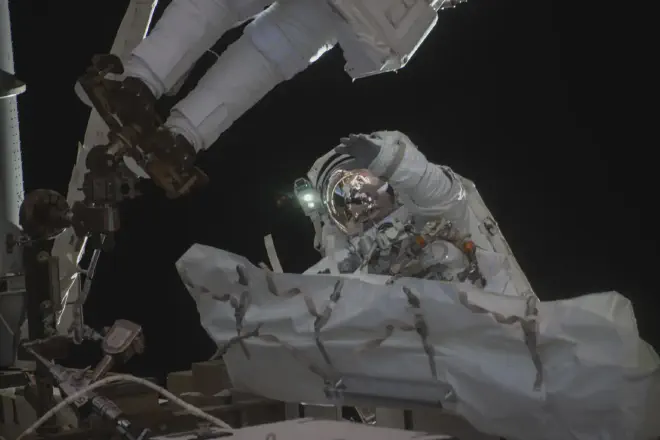
NASA astronauts Chris Williams and Jessica Meir will exit the station’s Quest airlock to replace a wrist joint that malfunctioned during normal Canadarm2 operations on May 27 after the arm drew elevated motor current and did not move as expected.
NASA worked alongside Canadian Space Agency (CSA) to understand the issue and determined a spacewalk was required to replace the joint using a spare already aboard the space station. Repairs to robotics, like Canadarm2, are normal and expected after more than 25 years of continuous operations, as the system was designed with replaceable components and planned maintenance in mind.
This spacewalk will be the second for Williams and the fifth for Meir. Williams will serve as spacewalk crew member 1 and will wear a suit with red stripes. Meir will serve as crew member 2 and will wear an unmarked suit. It will be the 280th spacewalk in support of space station assembly, maintenance, and upgrades.
Daily activities #
The Expedition 74 crew members continued today their spacewalk preparations reviewing robotics activities and configuring tools. The orbital residents also kept up their ongoing biomedical research and advanced technology studies aboard the International Space Station.
Meir & Williams #
NASA flight engineers Chris Williams and Jessica Meir continued gearing up for their second spacewalk together set to begin at 8:35 a.m. EDT on Tuesday, June 30. The duo joined each other inside the Quest airlock and inspected the tethers that will secure the spacewalkers to the outside of the orbital outpost. They also collected and organized the equipment they will carry with them into the vacuum of space including pistol grip tools, cameras, stowage bags, and more. Williams and Meir will spend about six hours and 40 minutes next week replacing a malfunctioned wrist joint on the Canadarm2 robotic arm. NASA and the Canadian Space Agency (CSA) officials will preview the upcoming spacewalk tasks during a news conference, tomorrow, on NASA’s YouTube channel at 2 p.m.
Williams and Meir also gathered with flight engineers Jack Hathaway of NASA and Sophie Adenot of ESA (European Space Agency) and called down to mission controllers in Houston, Texas, to talk about the upcoming spacewalk procedures. *Afterward, the quartet practiced on a computer the delicate robotic maneuvers required to access and replace the wrist joint on the *Canadarm2. Hathaway and Adenot will support the two spacewalkers next week helping them in and out of their spacesuits, monitoring their spacewalking activities, and carefully adjusting the Canadarm2 into position during the repair work.
Eye esams #
What about Russian cosmonauts? #
Cosmonauts Sergey Kud-Sverchkov and Sergei Mikaev, the station’s commander and flight engineer from Roscosmos, also conducted eye checks, this time using the Ultrasound 3 device inside the Columbus laboratory module. Doctors on the ground monitored the ultrasound scans in real time to detect potential space-caused changes to eye pressure and structure. The duo then took turns testing artificial intelligence tools to boost crew efficiency and communications in space. Roscosmos flight engineer Andrey Fedyaev focused on studying how living in space affects the human body throughout Wednesday.
Fedyaev kicked off his shift placing sensors on his chest to measure his heart’s electrical activity. Next, he attached cuffs to his arm, wrist, and fingers measuring his blood pressure. Doctors are exploring how the circulatory system adjusts in microgravity since the human heart doesn’t pump blood as hard as it does on Earth. Finally, the two-time space lab resident wore an acoustic sensor around his neck that recorded his rapid exhalation for insights into his respiratory health.
Contact [Notaspampeanas](mailto: notaspampeanas@gmail.com)