


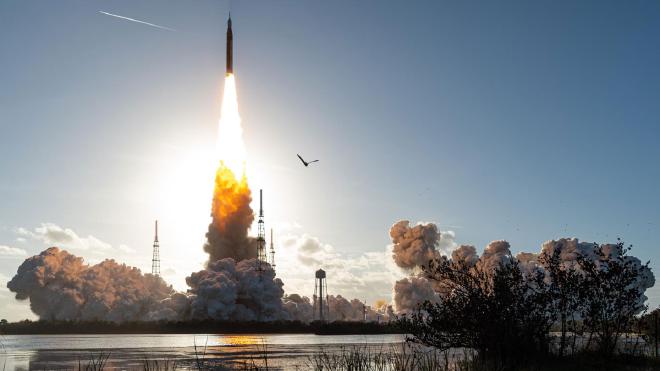
In an article signed by Sarah Stanley we read that the space industry is surging. In coming years, nearly 10,000 spacecraft are slated to launch into low-Earth orbit for a variety of purposes, such as global surveillance, space tourism, and satellite “megaconstellations” providing internet service.
Source: Earth’s Future
Rocket engine exhaust, as well as the burnup of inactive satellites and rocket parts reentering Earth’s atmosphere, releases a suite of pollutants. These chemicals have long been considered to pose little threat to our climate, given the historically small size of the space industry. Now, the sector’s rapid growth will send its emissions skyrocketing—but scientists don’t yet have a clear picture of the environmental ramifications.
An analysis by Vliex et al. of rockets launched in 2022 revealed that spaceflight depletes the ozone layer and contributes to global warming, with a significant portion of this ozone loss attributable to nitrogen oxide emissions released by objects reentering Earth’s atmosphere.
Incorporation of the calculated emissions into GEOS-Chem, a computational model of atmospheric chemistry, revealed their ozone-depleting and Earth-warming effects, with reentry emissions identified as playing a key role in ozone depletion. The researchers found that accounting for plume reactions reduced the estimated effects of spaceflight emissions, highlighting the value of considering plume chemistry in future assessments.
The analysis also underscored the varying effects of different rocket fuel types. Solid-state fuels, used recently in rocket boosters for NASA’s Artemis II mission to return astronauts to the Moon, appeared to cause the greatest amount of ozone depletion relative to propellant mass, while rocket-grade kerosene caused the greatest amount of warming.
—Sarah Stanley, Science Writer
Citation: Stanley, S. (2026), Rocket launches and reentries harm Earth’s ozone layer, Eos, 107, https://doi.org/10.1029/2026EO260183. Published on 8 June 2026. Text © 2026. AGU. CC BY-NC-ND 3.0 Except where otherwise noted, images are subject to copyright. Any reuse without express permission from the copyright owner is prohibited.
- The article The Role of Propellant Type, Re-Entry, and Plume Reactions in the Atmospheric Impacts of Spaceflight was published in Earth’s Future. Auhors: Yvar S. W. Vliex, Jurriaan A. van ’t Hoff, Irene C. Dedoussi First published: 19 May 2026 https://doi.org/10.1029/2025EF007795
Contact [Notaspampeanas](mailto: notaspampeanas@gmail.com)