


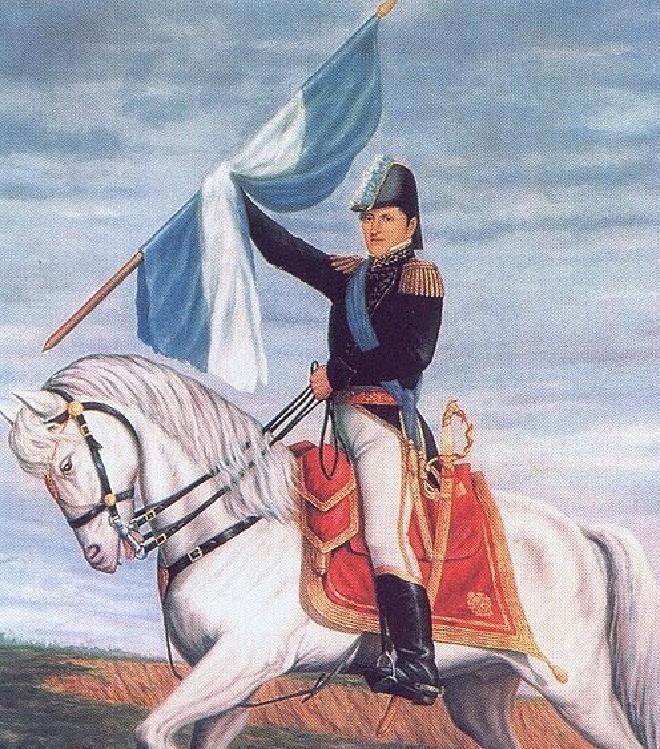
The performance -as the APN said- will offer a visual journey through history and national identity, with a staging where light blue and white are the main protagonists.
The objective is to pay homage to the symbols that represent the national character and reinforce the feeling of unity among Argentine people on a date that evokes collective memory.
The projection mapping technique consists of projecting 3D audiovisual images onto the façade of real buildings. It creates a light and sound show in which the buildings seem to come to life.
From English Wikipedia #
Manuel José Joaquín del Corazón de Jesús Belgrano (3 June 1770 – 20 June 1820), usually referred to as Manuel Belgrano, was an Argentine public servant, economist, lawyer, politician, journalist, and military leader. He took part in the Argentine Wars of Independence and designed what became the flag of Argentina. Argentines regard him as one of the main Founding Fathers of the country. He was also a supporter of free trade.
As a delegate for the Junta, he led the ill-fated Paraguay campaign of 1810-1811. Belgrano’s troops were beaten by Bernardo de Velasco at the battles of Paraguarí and Tacuarí. Though his army was defeated, the military campaign initiated the chain of events that led to the independence of Paraguay in May 1811. He retreated to the vicinity of Rosario, to fortify it against a possible royalist attack from the Eastern Band of the Uruguay River. While there, he developed the design of the flag of Argentina. The First Triumvirate did not approve the flag, but because of slow communications, Belgrano would only learn of that many weeks later, while reinforcing the Army of the North at Jujuy. There, knowing he was at a strategic disadvantage against the royalist armies coming from Upper Peru, Belgrano ordered the Jujuy Exodus, which evacuated the entire population of Jujuy Province to San Miguel de Tucumán. His counter-offensive at the Battle of Tucumán resulted in a key strategic victory, and it was soon followed by a complete victory over the royalist army of Pío Tristán at the Battle of Salta. However, his deeper incursions into Upper Peru ended with the defeats of Vilcapugio and Ayohuma, leading the Second Triumvirate to order his replacement as Commander of the Army of the North by the newly arrived José de San Martín. By then, the Asamblea del Año XIII had approved the use of Belgrano’s flag as the national war flag.
Contact [Notaspampeanas](mailto: notaspampeanas@gmail.com)