


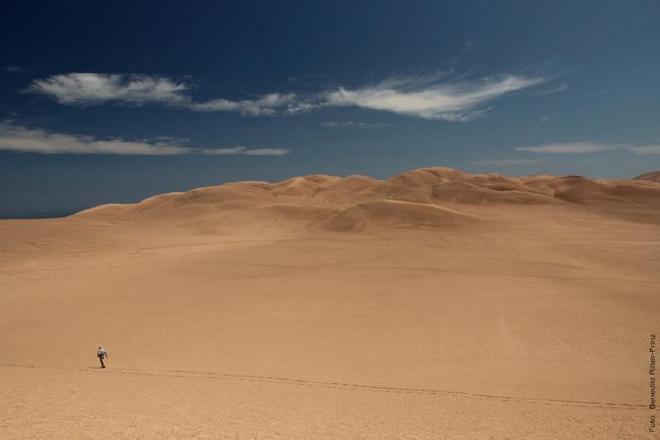
El estudio, titulado “Evidencia de aridificación del núcleo hiperárido del desierto de Atacama durante el Eoceno”, se publicó en la revista Nature Communications en colaboración con científicos del Centro de Investigación Ambiental de las Universidades Escocesas en Glasgow y la Universidad Goethe de Frankfurt.
Evidencia sin precedentes a partir de los clastos superficiales más antiguos de la Tierra #
El estudio se basa en la datación mediante nucleidos cosmogénicos. Este método detecta isótopos raros que se crean cuando la radiación cósmica incide y reacciona con los minerales de la superficie terrestre. El equipo analizó fragmentos de cuarzo —conocidos como clastos de cuarzo— y determinó las concentraciones de 21Ne (y, en algunos casos, de 10Be). Estos isótopos solo se acumulan mientras las rocas de la superficie terrestre están expuestas a la radiación cósmica.
«En las regiones más templadas, las precipitaciones impulsan la erosión y el transporte de sedimentos, remodelando constantemente el paisaje», explicó el profesor Tibor Dunai de la Universidad de Colonia. «En cambio, el núcleo hiperárido del desierto de Atacama, con menos de 2 milímetros de precipitación anual, presenta procesos superficiales extraordinariamente lentos. El paisaje permanece prácticamente inalterado a lo largo de escalas de tiempo geológicas».
En cambio, la extrema aridez aparentemente comenzó con el enfriamiento global posterior al EECO, que redujo aún más la ya baja humedad en la región. Con el tiempo, los cambios tectónicos y oceanográficos intensificaron y expandieron estas condiciones, dando forma al desierto tal como lo conocemos hoy.
La vinculación del desarrollo del paisaje, el clima y la vida en el límite árido #
El agua es el requisito más importante para un planeta habitable. Sin embargo, muchas regiones de la Tierra sufren una grave escasez de agua. En estos entornos, tanto la actividad biológica como los procesos superficiales se ven severamente restringidos; sus interacciones aún no se comprenden del todo. El desierto de Atacama, uno de los lugares más áridos de la Tierra, constituye un laboratorio natural para investigar estas relaciones.
«Nuestros resultados establecen un marco climático sólido a largo plazo para una de las regiones con mayor escasez de agua del planeta», afirmó el Dr. Benedikt Ritter-Prinz, profesor habilitado de la Universidad de Colonia. «Esto es fundamental para comprender cómo evolucionan los paisajes y cómo se adapta la vida a condiciones ambientales extremas».
¿Un panorama inevitable? #
Este estudio contribuye a identificar umbrales para la colonización biológica, comprender mejor los puntos de inflexión en los procesos de la superficie terrestre y reconstruir trayectorias climáticas a largo plazo en condiciones ambientales extremas. Asimismo, respalda nuevos enfoques de investigación sobre los tiempos de retardo evolutivo, la adaptación de las especies a los cambios climáticos y la interacción entre los procesos geológicos y la biodiversidad.
«Este trabajo demuestra la extraordinaria lentitud con la que pueden desarrollarse procesos en la superficie terrestre a lo largo de decenas de millones de años», afirmó el Dr. Benedikt Ritter-Prinz. «Abre nuevas perspectivas sobre las interacciones entre el clima, los paisajes y la vida en los entornos más extremos de nuestro planeta».
Cita #
- El estudio Evidence for Eocene aridification of the Atacama Desert’s hyperarid core (Evidencia de aridificación durante el Eoceno del núcleo hiperárido del desierto de Atacama) fue publicado en Nature Communications. Autores: Benedikt Ritter-Prinz, Steven A. Binnie, Finlay M. Stuart, Derek Fabel, Richard Albert, Volker Wennrich & Tibor J. Dunai
Contacto [Notaspampeanas](mailto: notaspampeanas@gmail.com)