


  1. Posts/

Rainforest foragers intensified plant use long before agriculture

·4 mins·
Notaspampeanas
Max Planck Institute of Geoanthropology Food Land Use Anthropology Hunter Gatherers Archaeology Geoanthropology Sri Lanka Plant Consumption Agriculture Late Pleistocene Holocene
Notaspampeanas
Author
Notaspampeanas
Digging on curiosity and science.
Table of Contents

A new study published in Nature Ecology and Evolution examining human populations in Sri Lankan tropical rainforests shows that people’s consumption of plants began increasing thousands of years before the introduction of agriculture. The research focuses on human and animal remains dating from approximately 20,000 to 3,000 years ago and uses zinc isotope analysis of tooth enamel to reconstruct an organism’s position in the food web – known as a trophic position – and dietary composition.

![Dr. Nicolas Bourgon preparing samples for zinc stable isotope analysis using a Thermo Scientific Neptune MC-ICP-MS, used to measure isotopic compositions in this study. Image credit: Max Planck Institute of Evolutionary Anthropology]Dr. Nicolas Bourgon preparing samples for zinc stable isotope analysis using a Thermo Scientific Neptune MC-ICP-MS, used to measure isotopic compositions in this study. Image credit: Max Planck Institute of Evolutionary Anthropology

The results show that humans consistently occupied an intermediate, omnivorous position in the food web, with diets including both animal and plant resources. However, over time, the isotope data reveal a gradual shift toward values associated with greater plant consumption. This trend begins in the Late Pleistocene and continues into the Holocene, far earlier than the first confirmed evidence for domesticated crops in the region. Rather than reflecting a sudden agricultural ‘revolution’, the findings point to a long-term process of plant engagement among rainforest hunter-gatherers.

“Our results show that plant use was not a late development linked to farming, but part of a much longer trajectory,” said Dr. Nicolas Bourgon, lead author of the study and postdoctoral researcher in the Department of Coevolution of Land Use and Urbanisation at the Max Planck Institute of Geoanthropology. “These rainforest populations were already intensifying their use of plant resources thousands of years before agriculture appears in the archaeological record.”

The study builds on decades of archaeological work at key cave sites, including Fa-Hien Lena, Batadomba-lena, and Balangoda Kuragala, which have produced evidence for sustained human occupation of tropical rainforest environments over tens of thousands of years. While previous interpretations have often emphasized hunting, largely due to the preservation of animal remains and tools, direct evidence for plant consumption has remained limited because organic materials rarely survive in such settings.

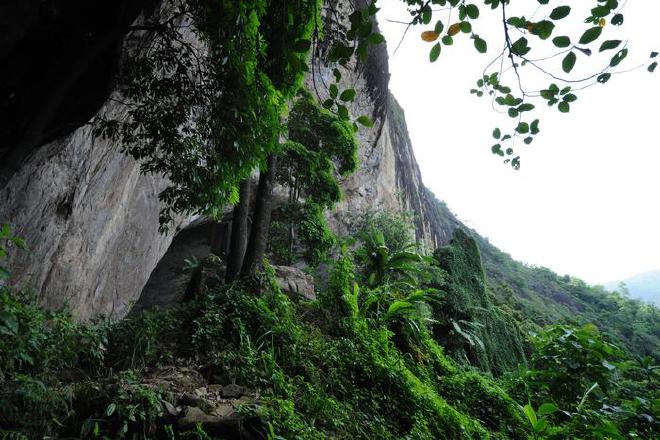
Entrance of Fa-Hien Lena Cave, one of the key archaeological sites included in this study, located on a cliff and overlooking the surrounding tropical rainforest environment. Image credit: Oshan Wedage

To address this gap, the researchers applied state-of-the-art zinc isotope analysis (δ⁶⁶Zn) to tooth enamel from 24 human individuals and 57 faunal samples. This method that reflects an individual’s trophic level and is particularly suited to tropical contexts.

The geochemical data indicate suggest that plant foods were consistently a substantial part of human diets, but became increasingly important over time. This suggests a gradual shift in how rainforest resources were used and managed, rather than a simple response to the later introduction of agriculture.

“The Sri Lankan archaeological record provides a rare opportunity to examine long-term human–environment interactions in a tropical setting,” said Dr. Oshan Wedage, from the Department of History and Archaeology at the University of Sri Jayewardenepura. “These results highlight how local populations adapted their resource use over time, particularly in relation to plant exploitation.”

“This study contributes to a growing body of evidence that tropical rainforests were not barriers to human occupation,” said Prof. Patrick Roberts, director of the Department of Coevolution of Land Use and Urbanization at the Max Planck Institute of Geoanthropology. “Instead, they were environments where people developed dynamic subsistence strategies and interacted with their surroundings over very long timescales.”

Beyond its regional implications, the study contributes to broader discussions about the origins of agriculture, land use, and the role of plant use in human evolution. The findings support models in which agriculture emerges from long-standing foraging practices rather than abrupt subsistence shifts.

Citation
#

  • The study Pre-agricultural intensification of plant use in Pleistocene Sri Lankan rainforests was published in Nature Ecology & Evolution. Authors: Nicolas Bourgon, Marcus Oelze, Noel Amano, Oshan Wedage, Nimal Perera & Patrick Roberts

Article Open access Published: 20 May 2026 Pre-agricultural intensification of plant use in Pleistocene Sri Lankan rainforests Nicolas Bourgon, Marcus Oelze, Noel Amano, Oshan Wedage, Nimal Perera & Patrick Roberts Nature Ecology & Evolution (2026)


Contact [Notaspampeanas](mailto: notaspampeanas@gmail.com)


Related

Peruvian indigenous have a digestive superpower; researchers think it may be linked to potatoes
·6 mins
Notaspampeanas
Anthropology Culture Anthropology Evolution Food Digestion Peruvian Andes Potatoes AMY1 Latin American Biological Sciences Earth Sciences
Is organic farming the solution to enhance natural drought resilience in crops?
·3 mins
Notaspampeanas
Agriculture Microbiology Microbiomes Bacteria Bacillus Climate Change
Does agriculture and climate affect feeding activities of soil animals?
·2 mins
Notaspampeanas
Göttingen University Soil Science Biodiversity Agriculture Climate Change Ecology Trophic Diversity Scientific Research Nature
Archaeological Expedition in Isla de los Estados: a strategic enclave for the Malvinas Islands
·9 mins
Notaspampeanas
Archaeology Archaeological Expedition Island of the States Malvinas Islands South Atlantic Isla De Los Estados CONICET Here Are Dragons Historical Border Archeology Study Group Institute of Archaeology
The duration of depression may influence how severely the disease alters the brain
·6 mins
Notaspampeanas
Resting-State Functional Connectivity Brain Network Interactions Depression Severity Mood Disorder University of São Paulo University of Oxford Neuroscience
The Big Bang of plant life: Discovery sheds light on how cells form walls
·4 mins
Notaspampeanas
Plant Biology Plant Science Cell Walls Cell Division IMK2 IMK3 Biofuels Washington State University Andrei Smertenko Institute of Biological Chemistry College of Agricultural, Human and Natural Resource Sciences