

  1. Posts/

Cosmic rays and atmospheric changes: An innovative study by CONICET scientists in Antarctica

·6 mins·
Notaspampeanas
Cosmic Rays Atmospheric Changes Antártida Neurus LAGO Collaboration CONICET IAFE Scientific Research Cherenkov Radiation Marambio Joint Antarctic Base San Martín Base Argentine Antarctic Institute Sergio Dasso Noelia Santos Atmospheric Sciences Particle Physics
Notaspampeanas
Author
Notaspampeanas
Digging on curiosity and science.
Table of Contents

Specialists from CONICET at the Institute of Astronomy and Space Physics (IAFE, CONICET-UBA), in collaboration with the Argentine Antarctic Institute (IAA) and the Department of Atmospheric and Oceanic Sciences (DCAO-FCEN, UBA), demonstrated that a cosmic ray detector called Neurus (built in IAFE’s space laboratories) and installed at the Marambio Joint Antarctic Base can be used not only to study space but also as a tool to monitor Earth’s atmosphere. The work was published in Earth and Space Science , one of the most prestigious journals of the American Geophysical Union (AGU).

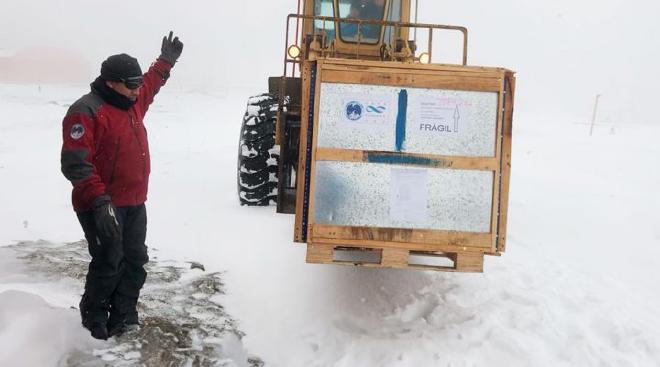
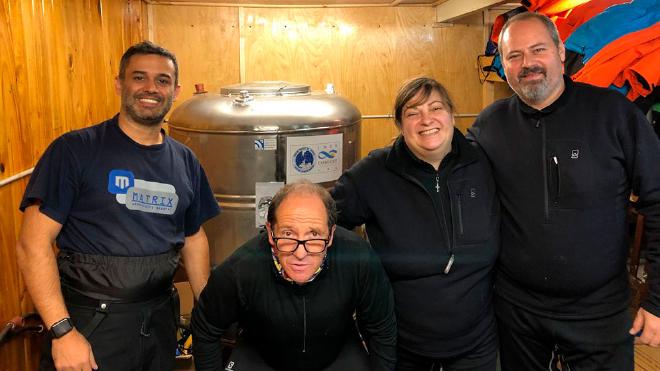
Alongside the newly unpacked Neurus equipment.

Cosmic rays are subatomic particles that travel through space at speeds close to the speed of light in a vacuum. This stream of particles is composed primarily of protons and atomic nuclei that constantly collide with Earth’s atmosphere. Upon colliding with atmospheric gases, these particles trigger a cascade or “rain” of secondary particles. It is these resulting particles that eventually reach the ground, allowing them to be studied using specialized detectors on the surface.

On the exterior of the cosmic ray laboratory that researchers were setting up in 2019.

“In this study, we used a detector in Antarctica to measure cosmic rays and investigate their relationship with atmospheric changes. We observed a strong correlation between cosmic ray levels and atmospheric pressure at an altitude of about 15 km. From this, we developed a model to estimate this variable using ground-level data. This approach offers a potentially practical and cost-effective method for monitoring the lower stratosphere in Antarctica, a region of particular interest due to its unique and dynamic behavior, which plays a fundamental role in global atmospheric processes,” said Sergio Dasso, PhD in Physical Sciences, one of the study’s authors and a CONICET researcher at IAFE and professor in the Department of Atmospheric and Oceanic Sciences (DCAO-FCEyN-UBA).

Neurus Detector
#

When an electrically charged particle travels through water faster than the speed of light in that medium, it produces a bluish flash known as Cherenkov radiation. The Neurus detector harnesses this effect to record the passage of secondary cosmic rays. “The device consists primarily of an ultrapure water tank equipped with a highly sensitive sensor (photomultiplier) capable of detecting and amplifying these extremely faint light pulses. Since these signals last only a few tens of nanoseconds, the electronic data acquisition system is cutting-edge, allowing us to precisely measure how many particles arrive and how much energy each one deposits, capturing something like the ‘fingerprint’ of the observed particle,” explained Noelia Santos, first author of the study, a graduate in Physical Sciences and PhD in Atmospheric Sciences from the University of Buenos Aires (UBA) (former CONICET doctoral fellow under the supervision of Dasso in the Department of Atmospheric and Oceanic Sciences (DCAO, FCEyN, UBA)).

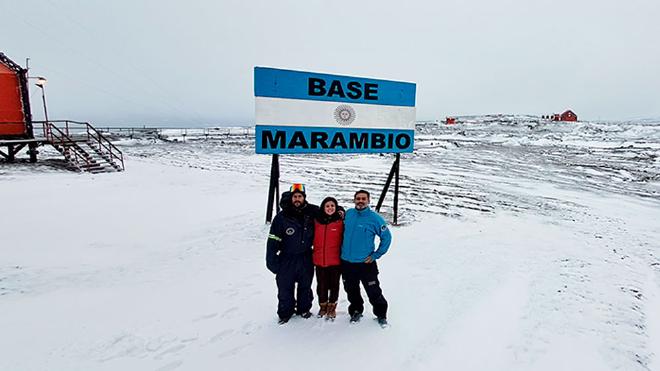
Arrival at Marambio Base to begin installing the laboratory and calibrating the particle detector.

Currently, Neurus records about 600,000 particles per hour. “Due to this large volume of information and connectivity limitations, the data is stored locally in Antarctica and only a processed summary is transmitted to the continent in real time,” Dasso explained.

Antarctic nodes: Marambio and San Martín
#

For the past two years, the project has had a second operational node at San Martín Base. “Although the analysis of this data is ongoing, the preliminary results are very promising. Comparing the particle flux between the two observatories (separated by approximately 700 km) will allow us to perform validations and spatial correlation studies to better understand the dynamics of radiation at different points on the Antarctic Peninsula,” explained Dasso.

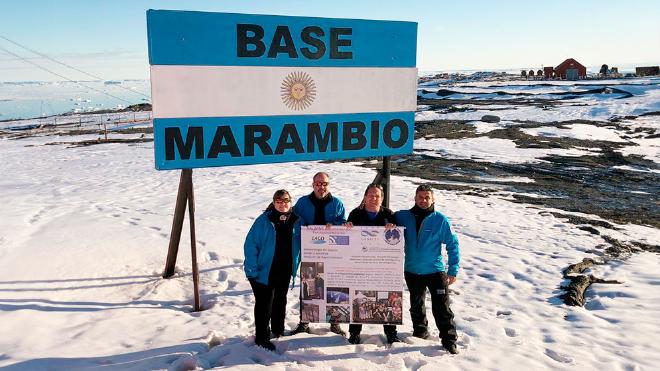
Working group at the Marambio base sign during the 2022–2023 Antarctic Campaign. From left to right: Lucas Rubinstein, Noelia Santos and Matías Pereira.

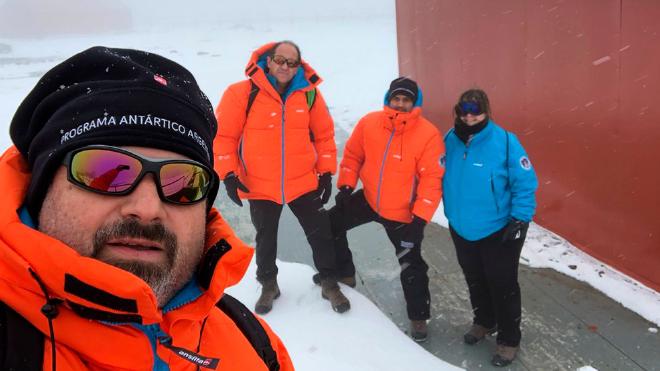
During the first Antarctic campaigns, to install and carry out significant upgrades at both Antarctic nodes (Marambio and San Martín), in addition to Dasso and Santos already mentioned, the following participated: CPAs from the Council, Matías Pereira, Lucas Rubinstein, Omar Areso, and doctoral fellow Javier Arellana (all from IAFE), as well as CONICET researcher Adriana Gulisano at the *Argentine Antarctic Institute (IAA). Many summer campaigns were carried out over several years.

About Neurus
#

Neurus is an Antarctic node of the international LAGO (Latin American Giant Observatory) collaboration, a detection network that extends from Mexico to Antarctica. This project originated from the Pierre Auger Observatory, located in Malargüe, province of Mendoza, Argentina. The Neurus Antarctic project is led by the Institute of Astronomy and Space Physics (IAFE, UBA-CONICET), in collaboration with the Argentine Antarctic Institute (IAA) and the Department of Atmospheric and Oceanic Sciences (DCAO-FCEN, UBA).

The current Neurus project required complex coordination spanning several critical stages. One was Technological Development: The detector was built entirely in IAFE’s space laboratories, improving upon previous designs of this type of detector. Specific atmospheric studies were conducted in collaboration with the DCAO to understand the site’s environment.

“Regarding Antarctic Logistics, we coordinated with the IAA for the deployment of campaigns, building adaptation, the installation of the laboratory on the white continent and the permanent presence of maintenance personnel at the bases,” said Dasso.

“Precision Infrastructure was another key element. The system features cutting-edge technology, such as time stamping for each particle with a resolution of 10 nanoseconds, thanks to GPS synchronization and FPGA-based electronics, and a telemetry system for transmitting data to our servers at IAFE, which allows us to make the data measured in Antarctica available almost instantaneously,” Dasso added.**

“This development is pioneering and original, as there are no other observatories of this kind currently operating in Antarctica. The results we found consolidate an innovative perspective: the use of cosmic rays as precision environmental sensors, opening new avenues for monitoring and better understanding Antarctic components of global circulation and the challenges posed by climate evolution from the perspective of cutting-edge physics,” Santos said.

Dasso concluded that “this work is the culmination of an institutional path that began more than 15 years ago, when our group at IAFE promoted the installation of cosmic ray detectors at Argentine Antarctic bases.”

Citation
#

Santos, NA, Gómez, N., Dasso, S., Gulisano, AM, Rubinstein, L., Pereira, M., … & LAGO Collaboration. (2025). Cosmic ray counting variability from water‐Cherenkov detectors as a proxy of stratospheric conditions in Antarctica. Earth and Space Science , 12 (11), e2025EA004298.

https://doi.org/10.1029/2025EA004298

Summary of the selection of outstanding papers made by the editors of AGU (published in EOS-AGU): Linking Space Weather and Atmospheric Changes With Cosmic Rays, by Graziella Caprarelli – 12 February 2026

https://eos.org/editor-highlights/linking-space-weather-and-atmospheric-changes-with-cosmic-rays

Dasso, S., Santos, NA, Gulisano, AM, Pereira, M., Rubinstein, L., & Areso, O. (2025). Daily cosmic ray counting and barometric pressure at ground level observed at Antarctic Peninsula (Marambio station) [Dataset]. Zenodo. https://doi.org/10.5281/zenodo.14900672


Contact [Notaspampeanas](mailto: notaspampeanas@gmail.com)


Related

CONICET team develops a device for domestic use to remove micro and nanoplastics from water
·4 mins
Notaspampeanas
Microplastics Nanoplastics INTEMA CONICET UNMdP Science of Materials Technology of Materials 2025 Franco-Argentine Innovation Award Carla Di Luca Materials Development
CONICET scientists find a new 70-million-year-old reptile in Argentine Patagonia
·6 mins
Notaspampeanas
CONICET Paleoteius Lakui MACN Federico Agnolin Martín Ezcurra Paleoteius Late Cretaceous Argentine Patagonia National Geographic Society Paleontology Laboratory of Comparative Anatomy and Vertebrate Evolution Argentine Museum of Natural Sciences Río Negro Scientific Reports Allen Formation Yacimiento De Salitral Ojo De Agua Fundación Félix De Azara Gondwana Pangaea Scincomorpha High-Performance Computing Center National University of Cordoba
Probiotic yeasts from CONICET researchers show improvements in the fattening and intestinal health of pigs.
·5 mins
Notaspampeanas
Probiotic Yeasts CONICET Pig Cattle CIDCA Kluyveromyces Marxianus Malena Ferreyra Compagnucci Martín Rumbo
CONICET scientists are making progress in developing a digital diagnostic device for hepatitis E
·6 mins
Notaspampeanas
Hepatitis E CONICET ViroSensAr Network Gisens Biotech INIFTA INQUIMAE INSIBIO MIT Artificial Intelligence Bioelectronics Nanotechnology
FIL researchers discover an energetic “strategy” of the brucellosis bacteria to optimize its multiplication
·5 mins
Notaspampeanas
FIL CONICET Molecular and Cellular Microbiology Laboratory Microbiology Brucella Scientific Reports Mur Fur4
AGGRESCANAI, a software developed to study proteins associated with Alzheimer's, Parkinson's and other neurodegenerative diseases
·3 mins
Notaspampeanas
AggrescanAI Leloir Institute Foundation CONICET Alzheimer Parkinson ELA Neurodegenerative Diseases ITBA Art