


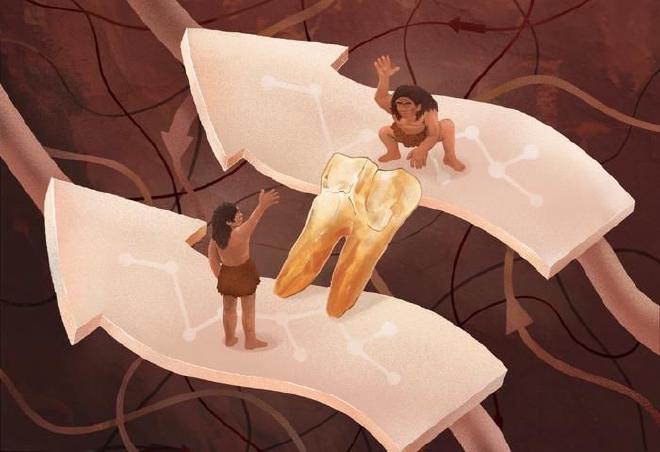
Homo erectus, or H. erectus, was the first species within the genus Homo to leave *Africa, occupying a key position in human evolutionary history. However, due to the lack of molecular evidence from H. erectus, their genetic characteristics, population diversity, and especially their potential connections to modern humans remain unresolved. As a result, the role of H. erectus represents a major mystery and a focal point of debate in human evolution.
Now, however, the research team, led by FU Qiaomei from IVPP in collaboration with multiple institutions, has overcome this bottleneck by employing a micro-destructive sampling approach based on acid etching to recover molecular information from six Homo erectus teeth without damaging their morphology. The findings were published today in Nature
Two mutations #
The researchers identified two mutations from the fossil teeth, dating back to at least 400,000 years ago, from three different sites—Zhoukoudian (Peking Man), Hexian, and Sunjiadong. The mutations suggest genetic links between East Asian H. erectus and Denisovans, which themselves are linked to modern humans.
The second is the AMBN-M273V variant, previously thought to be specific to Denisovans. However, this study reveals that this variant is not unique to Denisovans but is shared by these H. erectus populations.
Additionally, the study establishes a suite of new experimental and computational methodologies, including a sex determination method for ancient hominins based on the male-specific enamel protein AMELY, a cross-validation approach using tandem mass spectrometry and multiple data analysis pipelines, and DNA analysis methods linked to specific amino acid variants. Together, these tools provide a new framework for systematic paleoproteomics research.
Citation #
- The article Enamel proteins from six Homo erectus specimens across China was published in Nature. Authors: Qiaomei Fu, Zhongyou Wu, E. Andrew Bennett, Song Xing, Qiang Ji, Zhe Dong, Huiyun Rao, Xuejun Gu, Yizhao Dang, Jun Xing, Kai Zhou & Xiaotian Feng
Funding #
This work was supported by the National Natural Science Foundation of China (L2424324), the Chinese Academy of Sciences (CAS) (YSBR-019), the Archaeological Talent Promotion Program of China (2024-278) and the New Cornerstone Science Foundation.
Contact [Notaspampeanas](mailto: notaspampeanas@gmail.com)