


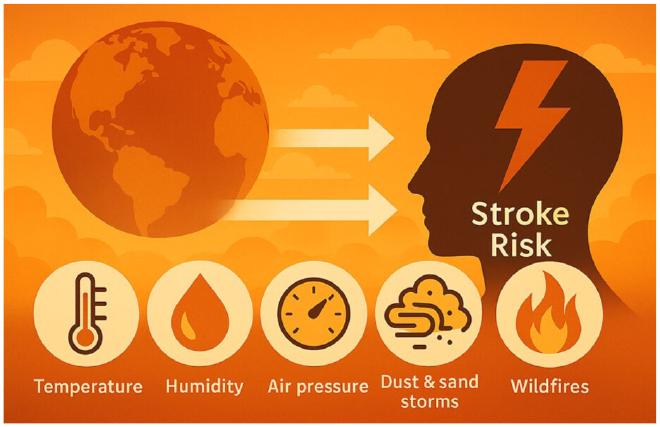
En un comunicado científico publicado en el International Journal of Stroke, la organización resume las últimas evidencias sobre la asociación entre el ictus y los factores ambientales agravados por el cambio climático, que incluyen temperaturas extremas, variabilidad de temperatura, humedad, presión barométrica, incendios forestales y tormentas de polvo y arena.
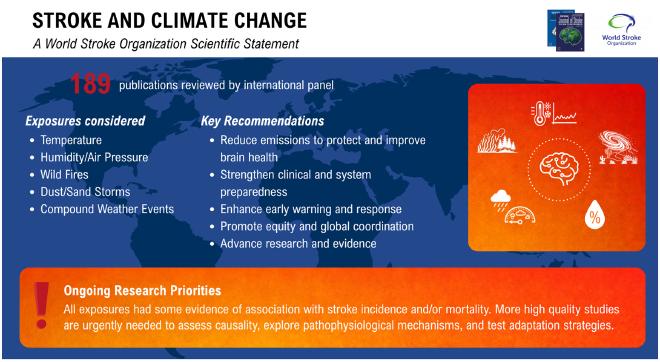
La autora principal principal de la investigación, profesora Anna Ranta, del Departamento de Medicina de la Universidad de Otago, Wellington, Nueva Zelanda, y miembro de la Junta Directiva de la Organización Mundial del Ictus, afirmó que un clima inestable aumenta tanto el riesgo de sufrir un ictus como de que los pacientes mueran como consecuencia.
“Temperaturas extremas, y los cambios rápidos de temperatura, humedad y presión del aire tienen un efecto fisiológico en el cuerpo humano. Las altas temperaturas pueden causar deshidratación, ’engrosando’ la sangre y aumentando el riesgo de obstrucción de los vasos sanguíneos, mientras que los cambios de humedad y presión atmosférica pueden aumentar la presión arterial, una causa importante de ictus”, señaló Ranta.
“Los cambios absolutos y las variaciones de temperatura, de presión barométrica y humedad —patrones que se están intensificando como resultado del cambio climático— tienen un impacto en el riesgo de ictus”, añadió.
“La contaminación del aire es otro factor importante que aumenta el riesgo de ictus, con más del 20 por ciento de los ictus a nivel mundial atribuidos a esta causa”, dijo.
“Aunque el transporte y las emisiones industriales son principalmente una causa, y no un efecto del cambio climático, el aumento en la frecuencia y gravedad de incendios forestales, tormentas de arena y polvo se ha relacionado directamente con el cambio climático. Las partículas derivadas de los ‘contaminantes atmosféricos’ entran en el torrente sanguíneo a través de los pulmones y causan daños en las paredes de los vasos sanguíneos. Esto puede provocar obstrucción y ruptura de arterias cerebrales y causar un ictus”, detalló.
El comunicado de la Organización Mundial del Ictus afirmó que avanzar en los esfuerzos para reducir las emisiones de gases de efecto invernadero es vital para disminuir los factores ambientales que impulsan el riesgo de ictus y proteger la salud cerebral de la población a largo plazo.
¿Qué hacer? #
El artículo científico fue elaborado por un panel internacional, liderado por la profesora Ranta, e incluyó expertos en cambio climático y medicina climática, así como especialistas en ictus de Nueva Zelanda, Asia, Europa, Oriente Medio y Norte de África, y América del Norte y del Sur.
Es un orgullo que el médico argentino Conrado Estol esté entre los autores de la investigación.
Cita #
- El estudio Stroke and climate change: A World Stroke Organization scientific statement (Ictus y cambio climático: una declaración científica de la Organización Mundial del Ictus) fue publicado en International Journal of Stroke. Autores: Ali Saad, Maria Khan, Conrado Estol, Mohammad Wasay, Tomoaki Kameda, Teresa Ullberg, Yannick Béjot, Serefnur Ozturk, Maria Epifania Collantes, Carol Zavaleta-Cortijo, Janice Kang, Alexandra Macmillan, Daniel G Kingston, Janet Stephenson, Jacques Reis, y Anna Ranta
Declaración de conflicto de intereses (COI) #
- Los autores declararon los siguientes posibles conflictos de interés respecto a la investigación, autoría y/o publicación de este artículo: Yannick Béjot informa de honorarios personales de BMS, Pfizer, Medtronic, Boehringer-Ingelheim, Amgen, Servier, NovoNordisk, Novartis y Argenx fuera del trabajo presentado.
Financiación #
- Los autores no recibieron apoyo financiero para la investigación, autoría y/o publicación de este artículo.
Contacto [Notaspampeanas](mailto: notaspampeanas@gmail.com)