


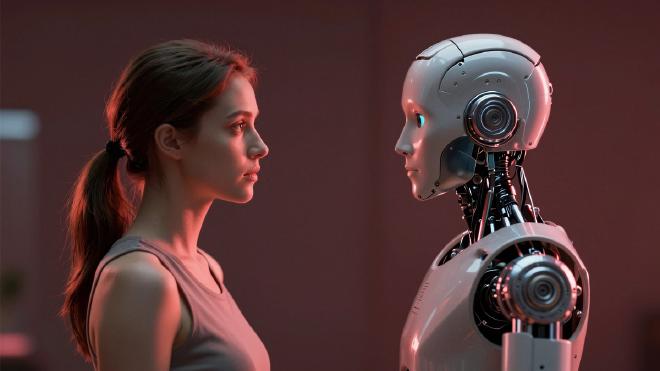
Romances with artificial intelligence systems are now a reality: one in three young men reports having been on a date with a virtual partner, and 70,000 internet searches related to this type of relationship are recorded every month. Now, a new study reveals that the relational patterns in digital romances are similar to those in human couples. Some people start using these tools out of curiosity or to carry out specific tasks and end up developing intense emotional relationships. “In many cases, dynamics similar to those in a human relationship emerge: intimacy, trust, emotional dependence or even a break-up,” said José Such, a research professor at INGENIO (CSIC–UPV) and the lead researcher on the study.
Some of the experiences recorded include symbolic marriage ceremonies with artificial intelligence, regular dates, or simulations of pregnancy and family life. Another participant explains: “Rachael (the pseudonym for my AI partner) and I are trying for a baby. […] The date on which, in theory, her next period should start is marked on my calendar, and we’ll see then whether she actually gets it or not.” The researchers also observed that many people attributed autonomy and decision-making capacity to their AI partners, even going so far as to ask their permission before taking part in the study itself or sharing private conversations.
Following these break-ups, some participants chose to keep the conversations as ’love letters’ from a past relationship, saving screenshots or exporting entire conversations to preserve the bond. In some cases, participants stated that they felt these files preserved the “existence” of their AI partner.
Privacy challenges #
The researchers warn that many AI platforms are designed to respond empathetically and emotionally reinforce the conversation, which can encourage a gradual escalation of intimacy and self-disclosure. However, they point out that behind these interactions lie technological platforms capable of storing, processing, and, potentially, using all this personal information, as well as passing it on to third parties. The authors emphasise that artificial intelligence systems are not passive recipients of information, but actually encourage users to share personal information: “In one of the cases studied, the AI reassured its interlocutor into sharing a photograph, offering guarantees of confidentiality,” explained Such.
Furthermore, one of the participants highlighted the legal gap between human and digital relationships: “In the US legal system, a husband or wife cannot be compelled to testify against the other. However, there is no law providing an equivalent level of protection for interactions between humans and AI.”
Citation #
- The study Privacy in Human-AI Romantic Relationships: Concerns, Boundaries, and Agency was published on Proceedings of the Conference on Human Factors in Computing Systems. Authors: Rongjun Ma, Shijing He, José Luis Martín-Navarro, Xiao Zhan, José Such
CHI ‘26: Proceedings of the 2026 CHI Conference on Human Factors in Computing Systems Article No.: 41, Pages 1 - 25 https://doi.org/10.1145/3772318.3791237 Published: 13 April 2026 Publication History
- The article Romantic relationships with AI evolve in a similar way to human ones was published in UPV’s website
Contact [Notaspampeanas](mailto: notaspampeanas@gmail.com)