El Telescopio Espacial Webb observó cómo un planeta sobrevivió a la muerte de su estrella
·7 mins·
Notaspampeanas
Telescopio Espacial James Webb
Exoplanetas
WD 1856 B
TESS
Telescopio Espacial Spitzer
Enanas Blancas
Química Atmosférica
Planetas Gigantes
Evolución Estelar
Autor
Notaspampeanas
Notaspampeanas
Tabla de contenido
Tabla de contenido
Un equipo internacional de astrónomos utilizó el Telescopio Espacial James Webb de la NASA/ESA/CSA para observar el tránsito del exoplaneta WD 1856 b, que tiene el tamaño de Júpiter, alrededor de su estrella anfitriona. Midieron la masa y la temperatura del planeta e incluso detectaron su atmósfera. Descubrieron que el planeta es significativamente más cálido de lo esperado y determinaron cómo probablemente alcanzó su órbita tan cercana alrededor de la estrella, una enana blanca. Estos resultados nos ofrecen una primera visión del futuro de planetas como Júpiter tras la muerte del Sol, dentro de miles de millones de años, según anunció la filial de divulgación de Webb de la Agencia Espacial Europea.
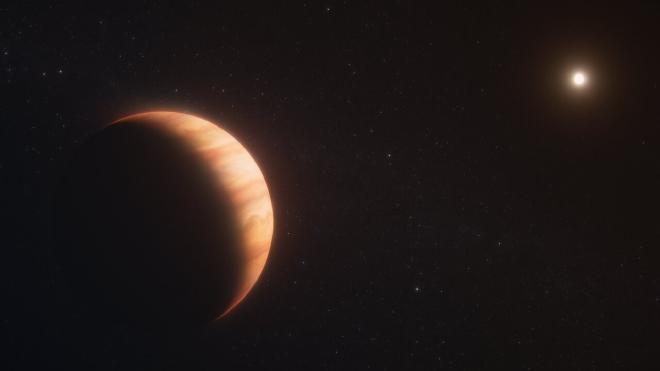
Concepto artístico de un planeta gigante gaseoso de color naranja a la izquierda, que ocupa aproximadamente un tercio del encuadre, y se encuentra frente a una estrella, que aparece en la parte superior derecha como un punto brillante mucho más pequeño. El planeta presenta sutiles bandas de nubes anaranjadas. La estrella ilumina el lado derecho del planeta como la media luna creciente. Ambos se encuentran sobre el fondo negro del espacio. Crédito de la imagen: NASA, ESA, CSA, R. Crawford (STScI)
Así, el telescopio Webb nos ofrece una nueva perspectiva sobre el futuro lejano de sistemas solares como el nuestro. Hace miles de millones de años, una estrella similar al Sol, cerca del final de su vida, creció enormemente hasta convertirse en una gigante roja antes de expulsar sus capas exteriores, dejando un núcleo caliente remanente conocido como enana blanca. Como gigante roja, la estrella debería haber engullido y destruido cualquier planeta cercano. Sin embargo, los astrónomos han descubierto un exoplaneta del tamaño de Júpiter orbitando la enana blanca cada 34 horas a una distancia inferior a 3 millones de kilómetros.
WD 1856 b fue descubierto en 2020 por científicos que utilizaron el Satélite de Sondeo de Exoplanetas en Tránsito (TESS) de la NASA y el Telescopio Espacial Spitzer. El planeta orbita la enana blanca WD 1856+534 a unos 80 años luz de la Tierra. “El planeta tiene un tamaño similar al de Júpiter, pero la enana blanca que orbita tiene el tamaño de la Tierra, por lo que el planeta es siete veces más grande que su estrella”, explicó el autor principal, Ryan MacDonald, de la Universidad de St. Andrews en el Reino Unido.
WD 1856 b orbita extremadamente cerca de su estrella anfitriona, a una distancia 50 veces menor que la que separa a la Tierra del Sol. Si WD 1856 b hubiera orbitado originalmente a esa distancia, habría sido aniquilado cuando la estrella era una gigante roja. ¿Cómo sobrevivió a la muerte de su estrella anfitriona y terminó en su posición actual?
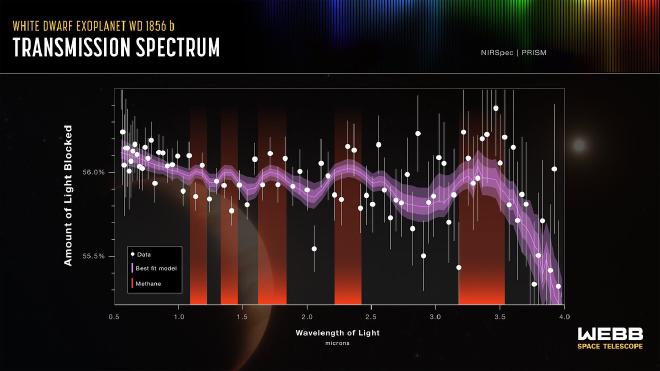
Esta imagen muestra un gráfico de la cantidad de luz bloqueada por porcentaje en el eje y y la longitud de onda de la luz en micras en el eje x. El eje y abarca desde 55,2% hasta 56,5% con marcas cada 0,1% y etiquetas en 55,5 y 56,0. El eje x abarca desde 0,5 hasta 4,0 micras con marcas cada 0,5 micras. Una línea púrpura gruesa delineada con dos bandas semitranslúcidas tiene una línea interior más oscura y una línea exterior más clara. La línea púrpura es ondulada y asciende, en el tercio superior, hasta aproximadamente 3,5 micras, donde desciende a 55,2 en el eje y y 4,0 en el eje x. Cinco picos están resaltados por barras rojas verticales, que indican la presencia de metano. Círculos blancos que representan puntos de datos están dispersos por encima y por debajo de la línea púrpura. Una leyenda muestra que la línea morada es el modelo que mejor se ajusta, el rojo resalta el metano y los círculos blancos representan los datos. Crédito de la imagen: NASA, ESA, CSA, J. Olmsted (STScI)
El nuevo estudio utilizó el telescopio Webb para observar el paso del planeta frente a su estrella. Este tránsito[^] proporcionó información única sobre la masa del planeta, que es entre cuatro y once veces la masa de Júpiter.
El equipo también pudo determinar la temperatura del planeta. Durante el tránsito, la luz de la estrella se bloqueó parcialmente, pero la luz infrarroja se redujo menos que otras longitudes de onda. La diferencia radicaba en la luz infrarroja emitida por el planeta debido a su propio calor. Los datos indicaron que el planeta tiene una temperatura de aproximadamente 126 grados Celsius, significativamente más alta de lo que sería si su única fuente de calor fuera la luz de la enana blanca. Este enigmático descubrimiento resultó ser la clave para demostrar cómo el planeta debió haber alcanzado su órbita actual.
Christopher O’Connor, de la Universidad Northwestern en Illinois (Estados Unidos), y coautor del artículo, fue el responsable de reconstruir la temperatura del planeta a lo largo del tiempo. O’Connor afirmó que “la gran incógnita es cómo WD 1856 b llegó a su posición actual, y existen dos teorías. Una es que el planeta fue engullido por la estrella anfitriona mientras agonizaba y logró sobrevivir en su interior. La otra es que la migración se produjo debido al efecto gravitacional de otros objetos del sistema. La enana blanca forma parte de un sistema estelar triple, y las estrellas compañeras exteriores podrían haber influido en la órbita de WD 1856 b”.
Los investigadores se percataron de que no existía ninguna fuente de energía que generara ese calor en la actualidad, por lo que debía tratarse de energía residual de un período anterior en el que el planeta se calentó. Utilizando modelos sobre cómo se enfrían con el tiempo los objetos subestelares como WD 1856 b, junto con los nuevos datos del telescopio Webb sobre la masa del planeta y su temperatura actual, el equipo pudo proyectar su temperatura hacia el pasado y deducir cuánto tiempo atrás debió haber ocurrido el calentamiento. La cronología es clave para determinar si el calentamiento se produjo al ser engullido por la gigante roja o durante una migración hacia el interior.
Concluyeron que el calentamiento probablemente ocurrió entre 3 y 5.5 mil millones de años después de que la estrella se convirtiera en una enana blanca. En este escenario, el planeta se encontraba en una órbita amplia que lo protegió de la estrella durante su fase de gigante roja destructiva, y solo migró a su ubicación actual posteriormente.«A medida que el planeta se desplazaba hacia el interior, sus interacciones con la fuerte gravedad de la enana blanca habrían provocado un calentamiento considerable, y desde entonces se ha estado enfriando», afirmó O’Connor.
La luz de la estrella que atravesaba la atmósfera del planeta también permitió obtener información sobre su composición química. «Observamos las características señales de pequeñas partículas de nubes e hidrocarburos, muy probablemente metano, lo que supone la primera vez que vemos una atmósfera en un planeta que transita una estrella muerta», declaró la coautora Victoria Boehm, de la Universidad de Cornell en Estados Unidos. «Recientemente observamos cuatro tránsitos más de WD 1856 b con el telescopio Webb para analizar con mayor profundidad la química de su atmósfera y estamos deseando ver los resultados», añadió.
El posible futuro del Sistema Solar que habitamos
#
En aproximadamente cinco mil millones de años, el Sol agotará su combustible de hidrógeno en su núcleo y se expandirá hasta alcanzar un tamaño más de 100 veces mayor que el actual, convirtiéndose en una estrella gigante roja. Posteriormente, desprenderá sus capas exteriores y finalizará su vida como una enana blanca. Mercurio, Venus y posiblemente la Tierra serán destruidos por la gigante roja. Sin embargo, es incierto el destino de los planetas más distantes, en particular los gigantes gaseosos. Encontrar y estudiar planetas en órbita alrededor de los restos de estrellas similares al Sol tras su muerte es una forma de comprender qué podría suceder en nuestro propio Sistema Solar en un futuro lejano.
El artículo Webb studies how a planet survived death of its star fue publicado hoy por ESAWebb, la sección europea de la colaboración entre la NASA, la ESA y la CSA en torno al Telescopio Espacial Webb. Autores: Ryan J. MacDonald, Christopher E. O’Connor, Victoria A. Boehm, E. M. May, David K. Sing, Elijah Mullens, L. C. Mayorga, Trevor O. Foote, Simon Blouin, Logan A. Pearce, Nikole K. Lewis, Jeff Valenti, Natasha E. Batalha, Maura Lally, Joshua D. Lothringer, Mark S. Marley, Ishan Mishra & Susan E. Mullally
[^]: Un tránsito ocurre cuando un planeta pasa frente a la estrella que orbita desde nuestra perspectiva, bloqueando parte de su luz. Muchos exoplanetas se han detectado buscando la pequeña disminución en el brillo de una estrella causada por un planeta en tránsito. Comparar la luz de la estrella con la luz que atraviesa la atmósfera del planeta en tránsito también proporciona información sobre la composición atmosférica