El telescopio Webb de la NASA halló pistas sobre el distante y antiguo origen del cometa 3I/ATLAS
·5 mins·
Notaspampeanas
Astronomía
Cometa Interstellar 3I/ATLAS
Telescopio Espacial James Webb
Goddard Space Flight Center
Química
Astroquímica
Autor
Notaspampeanas
Notaspampeanas
Tabla de contenido
Tabla de contenido
Cuando el cometa interestelar 3I/ATLAS comenzó a alejarse del Sol en diciembre de 2025, los astrónomos aprovecharon la oportunidad para dirigir, hacia él, el potente telescopio espacial James Webb de la NASA y obtener mediciones detalladas de sus componentes químicos. El cometa se había calentado recientemente tras su máximo acercamiento al Sol, y su antiguo hielo se había transformado en una brillante coma de gas ideal para la observación.
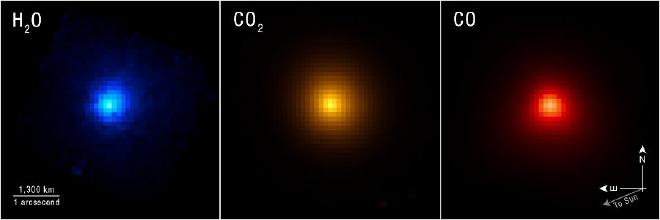
Los investigadores utilizaron el instrumento NIRSpec (espectrógrafo de infrarrojo cercano) del telescopio espacial James Webb de la NASA para mapear la composición química específica del cometa 3I/ATLAS mientras se alejaba del Sol. Créditos: Imagen: NASA, ESA, CSA, STScI, Martin Cordiner (CUA, NASA-GSFC); Procesamiento de imagen: Alyssa Pagan (STScI)
El telescopio Webb capturó datos detallados, incluyendo las proporciones químicas de carbono y deuterio, también conocido como hidrógeno pesado, que no se encuentran en los cometas de nuestro sistema solar. Los resultados sorprendieron a los investigadores. A partir de los componentes del cometa 3I/ATLAS, los astrónomos analizaron el entorno en el que se formó.
El nombre del cometa proviene de su condición de tercer cometa interestelar confirmado, lo que significa que se originó fuera del sistema solar, y del telescopio que lo detectó por primera vez, el ATLAS (Asteroid Terrestrial-impact Last Alert System), financiado por la NASA.
“Esta fue una oportunidad única para estudiar un objeto antiguo de una galaxia distante, probablemente anterior a nuestro Sol y sistema solar”, dijo el astroquímico Martin Cordiner del Centro de Vuelos Espaciales Goddard de la NASA, con sede en Greenbelt, Maryland, y autor principal del estudio. “Por un lado, obtenemos información directa sobre ese tiempo y lugar distantes, y por otro, aprendemos algo sobre lo inusual que puede ser nuestro propio sistema solar”, añadió.
Cordiner y su equipo de investigación se unieron a astrónomos de diversas subdisciplinas para observar al cometa 3I/ATLAS en su viaje a través del sistema solar. Recibieron autorización para interrumpir el programa de observaciones previsto del telescopio Webb y utilizar su instrumento NIRSpec (espectrógrafo de infrarrojo cercano) para estudiar el cometa.
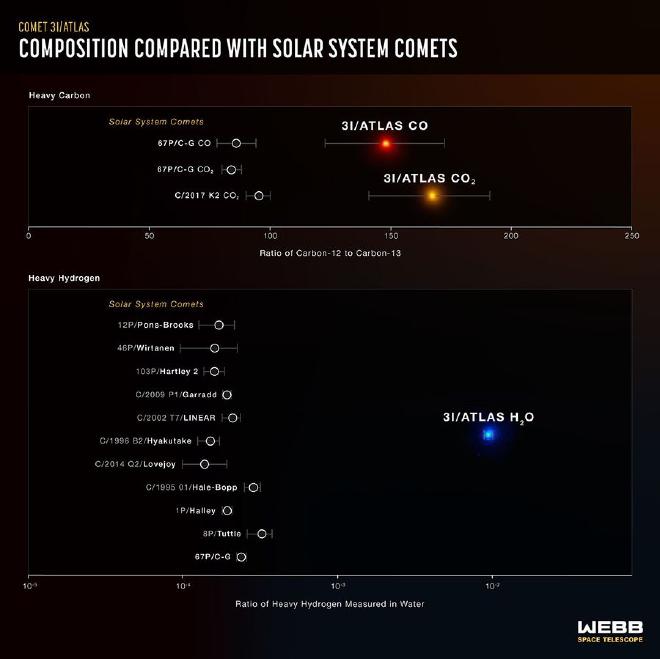
El instrumento NIRSpec reveló niveles excepcionalmente altos de deuterio, aproximadamente 30 veces superiores a los observados en los cometas del sistema solar. Esto sugiere que 3I/ATLAS pudo haberse originado en un sistema muy frío mucho antes en la historia de nuestra galaxia. Durante su formación, el material que se incorporó a 3I/ATLAS probablemente estuvo expuesto a abundante radiación, pero no a un calor prolongado que hubiera reprocesado su hielo de “agua pesada”, con deuterio, transformándolo en el tipo de hielo de H₂O que conocemos en la Tierra.
3I/ATLAS comparado con los cometas del Sistema Solar
#
Estos gráficos muestran la importante diferencia de composición entre el cometa interestelar 3I/ATLAS y los cometas originarios de nuestro sistema solar. Estos datos tan específicos ayudan a los investigadores a reconstruir el sistema planetario original del cometa. Ilustración: NASA, ESA, CSA, Martin Cordiner (CUA, NASA-GSFC), Leah Hustak (STScI)
Además, NIRSpec detectó solo trazas de carbono-13 en comparación con el carbono-12, más ligero. Esto también apunta a un origen muy antiguo para 3I/ATLAS, ya que los sistemas estelares se enriquecen con carbono-13 con el tiempo, a medida que nacen y mueren generaciones de estrellas en la galaxia. Por eso existen niveles más altos de carbono-13 en nuestro sistema, alrededor de nuestro Sol, que se formó hace relativamente poco tiempo, hace 4500 millones de años.
El equipo de investigación estima que 3I/ATLAS pudo haberse formado hace entre 10 y 12 mil millones de años, durante el “mediodía cósmico” del universo, cuando la formación estelar estaba en su apogeo. Su joven sistema de origen probablemente se encontraba inmerso en una nube relativamente fría y densa. La abundancia de agua pesada indica que 3I/ATLAS pasó sus años de formación en un estado de congelación profunda.
Un estudio independiente, realizado con el Very Large Telescope del Observatorio Europeo Austral, en Atacama, Chile, y dirigido por la astrónoma Cyrielle Opitom de la Universidad de Edimburgo, complementó los hallazgos de Webb con un análisis de las variedades de carbono y nitrógeno de 3I/ATLAS en forma del compuesto químico cianuro.
“Para nosotros, como científicos, encontrar estos isótopos raros es fascinante, pero lo más importante es explorar las posibilidades de la química prebiótica en otros lugares de la galaxia”, afirmó Stefanie Milam, del Centro Goddard de la NASA y coautora del estudio junto con Cordiner. “Hasta ahora, solo conocemos un lugar en el vasto cosmos donde los ingredientes químicos dieron origen a la vida: nuestro sistema solar, nuestra Tierra. El análisis de estos objetos interestelares representa un paso fundamental para comprender cuán comunes, o poco comunes, son las condiciones para la evolución de la vida en el universo”.
El Telescopio Espacial James Webb es el principal observatorio de ciencia espacial del mundo. Webb está resolviendo misterios de nuestro sistema solar, explorando mundos distantes alrededor de otras estrellas e investigando las misteriosas estructuras y orígenes de nuestro universo y nuestro lugar en él. Webb es un programa internacional liderado por la NASA junto con sus socios, la ESA (Agencia Espacial Europea) y la CSA (Agencia Espacial Canadiense).