Quantifying forks in Bitcoin mining—and their energy cost
·3 mins·
Notaspampeanas
Economics
Cryptocurrencies
Bitcoin
Mining
Energy Cost
Author
Notaspampeanas
Digging on curiosity and science.
Table of Contents
Table of Contents
Creating new cryptocurrency requires large amounts of computing power, which is used to solve cryptographic puzzles in what is known as proof-of-work mining. When two computers attempt to solve the same puzzle, the first to find the solution creates a new block and claims the right to create a predetermined amount of new coins, while the losers get nothing.
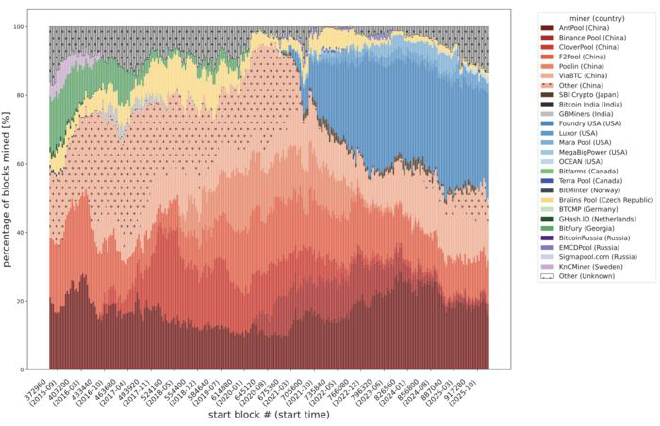
Share of blocks mined among miners in selected observation periods. Unknown miners, for which no specific signature is available, are in dotted white, and the other minority miners from China are in dotted light red. Image credit: Barucca et al.
Paolo Barucca and colleagues show that this system favors miners who have expensive specialized hardware, which can outperform off-the-shelf computers, leading to a consolidation of power in the industry.
Today, just three mining pools produce over 50% of new Bitcoin blocks. When two miners complete a puzzle nearly simultaneously, each miner produces a valid block. This situation is known as a “fork.”
Whichever miner can propagate the block to the network first will see their block built upon in the future, while the loser’s block becomes an orphaned block, on which few or no additional blocks will be built.
The computation used to mine on top of an orphaned block still requires significant energy—an inefficiency that increases cryptocurrency’s environmental impact.
The study authors model the fork rate in a network of heterogeneous miners as a function of the number of miners, their hash rate distribution, and block propagation times within the network.Using their model, the authors can quantify the power wasted in mining blocks on top of orphaned blocks.
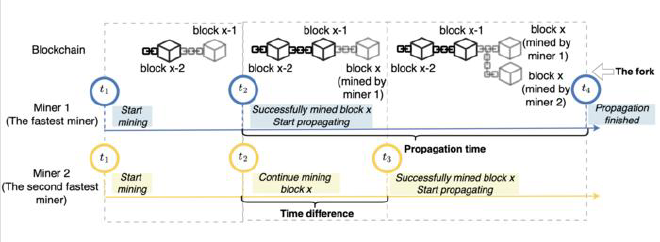
Fork generation. To simplify the dynamics for the models, the authors assume that all miners start mining at t1. At t2, Miner 1 solves the proof-of-work puzzle for block x and starts broadcasting it to the network. By t4, the message has spread to most of the nodes and a new block x + 1 is likely to be appended to block x. However, Miner 2 successfully mines the block at t3, which is later than t2 and earlier than t4. Therefore, based on the definition above, the propagation time is t4 − t2, and the fork is present between time t3 and t4. Image credt: Barucca et al.
According to the authors, this wasted energy has drastically increased over the past decade, peaking at around 16,000 MW in 2025, equivalent to half of the power generated in the United Kingdom.
The article How the interplay between power concentration, competition, and propagation affects the resource efficiency of distributed ledgers was published in the PNAS Nexus journal. Authors: Paolo Barucca, Carlo Campajola, Jiahua Xu
Paolo Barucca, Carlo Campajola, Jiahua Xu, How the interplay between power concentration, competition, and propagation affects the resource efficiency of distributed ledgers, PNAS Nexus, Volume 5, Issue 5, May 2026, pgag135, https://doi.org/10.1093/pnasnexus/pgag135