


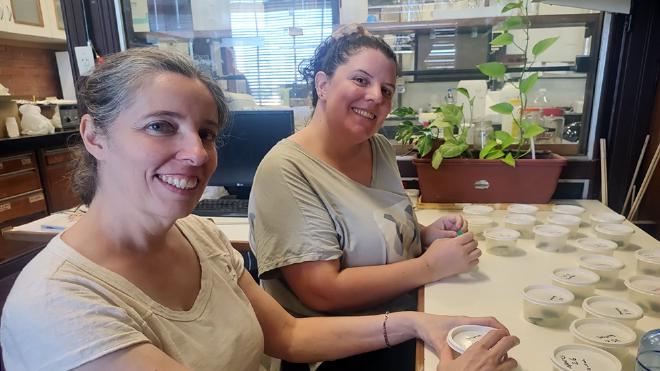
A team of scientists from CONICET at the Institute of Genetic Ecology and Evolution of Buenos Aires (IEGEBA, CONICET-UBA), led by researcher Marcela Rodriguero, works to unravel how certain endosymbiotic bacteria (living inside the cells of other organisms) influence the reproduction of Naupactini weevils: insects that can become important agricultural pests.
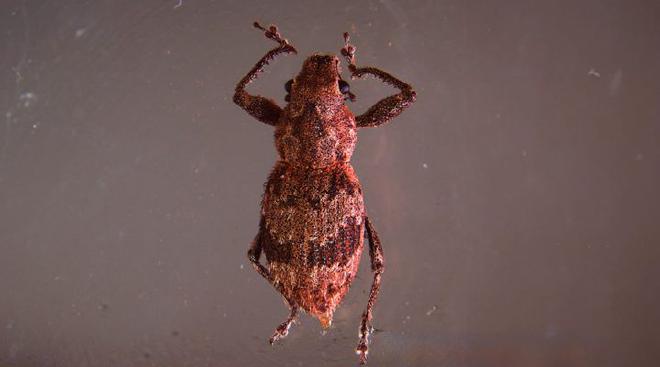
They recently released a work focused on two bacteria (Wolbachia and Rickettsia) and their relationship with a phenomenon called parthenogenesis, which allows females of certain species to reproduce without the need for fertilization. The advance, published in Insect Molecular Biology, was highlighted in the Journal Highlight of the Royal Entomological Society and could lay the foundations for optimizing existing techniques or control of these agricultural pests.
**“An antibiotic cure experiment suggested that it was necessary to reach a threshold of bacterial density (that is, a minimum concentration of bacteria) to cause parthenogenesis. We concluded this because by administering an antibiotic effective against Wolbachia we achieved sterility of the host females, although the infection was not cured absolutely,”**Rodriguero said, who is also a member of the Department of Ecology, Genetics and Evolution of the Faculty of Exact and Natural Sciences of the UBA. “So, it was evident that it was enough to reduce the amount of Wolbachia to make its effect on the reproduction of the weevils disappeared,” she added.
Step by step #
While parthenogenetic species possessed high densities of Wolbachia and Rickettsia and a very low or “residual” density of Spiroplasma, those that reproduce sexually had a very high density of Spiroplasma and only residual amounts of Wolbachia and Rickettsia. These results, obtained by CONICET researcher Lucía da Cruz Cabral, also a co-author of the work, were published in 2025 in an article in the journal Symbiosis.
At the same time that those experiments were taking place, Lucíaa Fernández Goya, lead author of the study published in Insect Molecular Biology and a CONICET postdoctoral fellow at IEGEBA, had already begun working with the goal of conclusively proving that the induction of parthenogenesis required a bacterial density threshold. To do this, she had to incorporate Rickettsia as one more variable to explore along with Wolbachia in the cure experiments she carried out over several summers.
The difficulty of doing so lay, mainly, in the fact that reproductive parasites are non-culturable bacteria. That is to say, they cannot be grown in a rich medium outside of their host, and therefore certain traditional microbiological techniques cannot be used to study them. “Everything is infinitely more difficult and expensive. And when the idea of the threshold began to be considered, there were no techniques that allowed for addressing the quantification of bacterial density in a rigorous manner in these non-culturable systems,” asserted Rodriguero.
But technical advances in molecular biology and statistics provided improvements in the quantification of bacterial load and in the processing of data, making the question legitimate once again. Furthermore, the context also changed: “our sexually reproducing weevils clamored for confirmation of the threshold,” stated Rodriguero.
Potential contribution to pest control #
For the authors of the study, the results obtained provide something key by demonstrating that in these insects, reproduction can depend strongly on bacterial symbionts and, in particular, on their density within the host. “This opens the possibility of considering control strategies that do not target the insect directly, but rather its microbiota. Within the tribe Naupactini there are several species considered pests, and one of the most emblematic is Naupactus cervinus, an invasive species in many regions of the world, parthenogenetic and infected with Wolbachia and Rickettsia, for which no males have been recorded for decades. In such a case, the dependence on the symbionts can be so strong that losing them would potentially mean a death sentence,” noted Fernández Goya.
Although the scientist considers it important to clarify that not all pests are parthenogenetic nor do all parthenogenetic species depend on symbionts to reproduce, she highlights that the existence of these associations can create points of vulnerability. “If one could interfere with those symbionts, the reproductive capacity of weevil populations could be affected. Studying these interactions and their dynamics within the host in detail may be key to thinking, in the future, about more specific, targeted, and potentially more environmentally friendly control strategies,” she stated.
What comes next? #
The authors of the study have sequenced the genomes of several strains of Wolbachia and Spiroplasma, as well as a strain of Rickettsia. “With them, we plan to carry out a preliminary study of the genes that encode the proteins mediating the change from sexual reproduction to parthenogenesis,” Rodriguero said. Although there are advances regarding other reproductive alterations induced by Wolbachia in mosquitoes and parasitoid wasps, knowledge about parthenogenesis is still incipient. “This genetic basis will allow us to design precise experiments, starting from a rigorous bioinformatic analysis. Furthermore, these genomes contain valuable information to unravel the triple interaction between Spiroplasma, Wolbachia, and Rickettsia (cooperation/competition),” Fernández Goya said.
Also participating in the study were Alejandra C. Scannapieco, from the “E. A. Favret” Institute of Genetics, National Institute of Agricultural Technology (INTA)—a group linked to the Institute of Agrobiotechnology and Molecular Biology (IABIMO-CONICET) and the Faculty of Agronomy at the UBA; Viviana A. Confalonieri, from the IEGEBA and the Department of Ecology, Genetics and Evolution of the Faculty of Exact and Natural Sciences at the UBA; and Analía A. Lanteri, from the Entomology Division at the La Plata Museum and the Faculty of Natural Sciences and Museum, National University of La Plata.
Citation #
-
Fernandez Goya, L., da Cruz Cabral, L., Scannapieco, A. C., Confalonieri, V. A., Lanteri, A. A., & Rodriguero, M. S. (2026). Endosymbiont load dictates reproductive fate: Experimental validation for the bacterial dosage model in a parthenogenetic weevil (Coleoptera, Curculionidae). Insect Molecular Biology, 35(3), 310–322. DOI: https://doi.org/10.1111/imb.70030
-
da Cruz Cabral, L., Fernandez Goya, L. & Rodriguero, M.S. You are what you harbour: contrasting microbial communities detected in parthenogenetic and sexual weevils. Symbiosis 97, 87–99 (2025). https://doi.org/10.1007/s13199-025-01082-x
-
Rodriguero, M.S., Confalonieri, V.A., Guedes, J.V.C. and Lanteri, A.A. (2010), Wolbachia infection in the tribe Naupactini (Coleoptera, Curculionidae): association between thelytokous parthenogenesis and infection status. Insect Molecular Biology, 19: 631-640. https://doi.org/10.1111/j.1365-2583.2010.01018.x
-
The article Nuevo hallazgo sobre la reproducción asexual en grupos de insectos que afectan cultivos agrícolas was published in CONICET’s news section
Contact [Notaspampeanas](mailto: notaspampeanas@gmail.com)