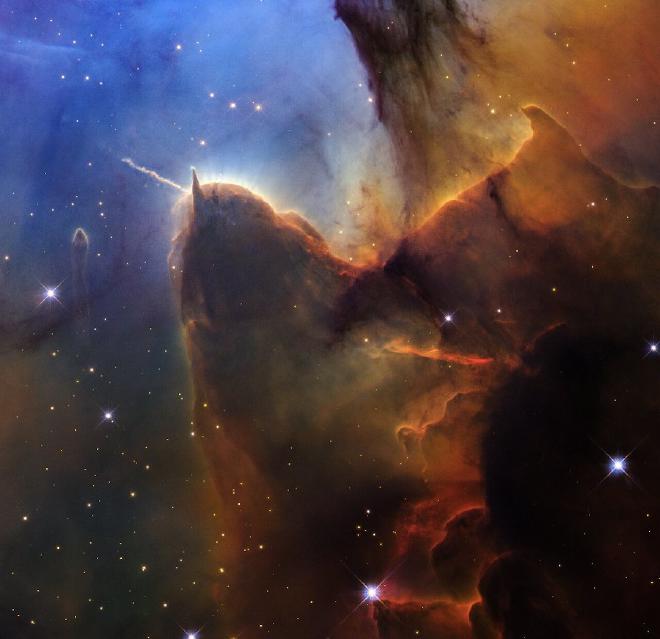
El Telescopio Espacial Hubble de la NASA/ESA observó una escena que capturó por primera vez en 1997 y fue republicada ayer en honor a su 36º aniversario: una pequeña porción de una región estelar que se forma a unos 5000 años luz en la constelación de Sagitario, conocida como la Nebulosa Trífida. La imagen muestra cambios en escalas de tiempo increíblemente cortas e infunde una sensación hipnótica y de asombro por nuestro cambiante Universo.
El Hubble nos fascina con una vista recortada de una vasta región de formación estelar conocida como la Nebulosa Trífida. La parte superior izquierda es de un azul brillante. Los colores marrón y ámbar van desde la parte superior derecha hasta el centro en líneas irregulares y superpuestas hasta la parte inferior central. En la esquina inferior derecha, la vista es casi negra. Pequeñas estrellas de color ámbar aparecen a lo largo de la escena. Hacia la izquierda hay una figura marrón prominente que parece una cabeza con dos cuernos. El cuerno izquierdo apunta hacia la izquierda y es ondulado. El cuerno derecho es triangular y apunta hacia arriba. El polvo marrón continúa, fluyendo hacia abajo, como si recorriera un respaldo, y subiendo hacia la parte superior derecha. Una línea prominente, de aproximadamente la misma longitud que el cuerno izquierdo, aparece debajo del centro del cuerpo y cambia de naranja a rojo. Un pequeño pilar semitransparente separado está a la izquierda de la cabeza. Aparecen en la mitad inferior unas pocas estrellas azules de primer plano ligeramente más grandes con cuatro picos de difracción. Crédito de la imagen: NASA, ESA, STScI. Image processing: J. DePasquale (STScI)
Los colores en la imagen de luz visible de Hubble de esta región brillante de formación estelar recuerdan a una escena submarina llena de sedimentos finos que revolotean por las profundidades del océano.
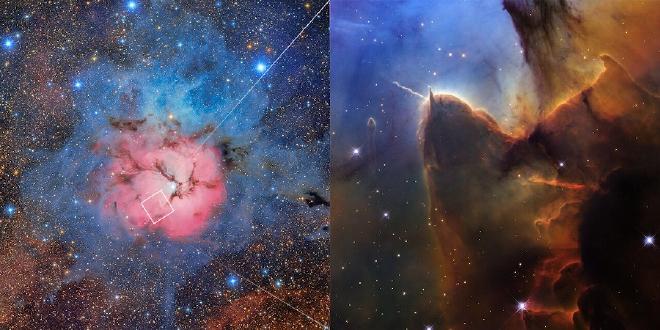
Imagen de la Nebulosa Trífida completa, tomada desde la superficie terrestre, se muestra en la mitad izquierda con una imagen insertada del Telescopio Espacial Hubble a la derecha. A la izquierda, un círculo irregular mayormente opaco ocupa la mayor parte de la vista. El círculo tiene un interior rosa brillante cruzado por algunos carriles oscuros y dentados de polvo. Una región significativa alrededor de eso parece azul. Los bordes tienen tonos naranjas y marrones, con el fondo negro estrellado del espacio que asoma a través. El primer plano del Hubble está delineado justo debajo del centro, a la izquierda. La parte superior izquierda es de un azul brillante. Los colores marrón y ámbar van desde la parte superior derecha hasta el centro en líneas irregulares y superpuestas hasta la parte inferior central. En la esquina inferior derecha, la vista es casi negra. Pequeñas estrellas de color ámbar aparecen a lo largo de la escena. Hacia la izquierda hay una figura marrón prominente que parece una cabeza con dos cuernos. Crédito de la imagen: NASA, ESA, STScI. Image processing: J. DePasquale (STScI)
Varias estrellas masivas, que están fuera de este campo de visión, han moldeado esta región durante al menos 300.000 años. Sus potentes vientos ultravioleta continúan soplando una enorme burbuja, una pequeña parte de la cual se muestra aquí, que empuja y comprime el gas y el polvo de la nube, desencadenando nuevas ondas de formación estelar.
No es la primera vez que el Hubble contempla esta escena. El telescopio observó la Nebulosa Trífida en 1997 y ahora, 29 años después, ha aprovechado casi toda su vida operativa para mostrarnos cambios en la nebulosa a escala temporal humana. ¿Por qué mirar el mismo lugar otra vez? Además de experimentar cambios con el tiempo, el Hubble también está equipado con una cámara mejorada con un campo de visión más amplio y mayor sensibilidad, que se instaló durante la cuarta misión de mantenimiento.
La vista del Hubble sobre la Nebulosa Trífida (también conocida como Messier 20 o M20) se centra en una ‘cabeza’ y un ‘cuerpo’ ondulante de una nube oxidada de gas y polvo que se asemeja a un limón marino, o babosa marina, que parece deslizarse por el cosmos.
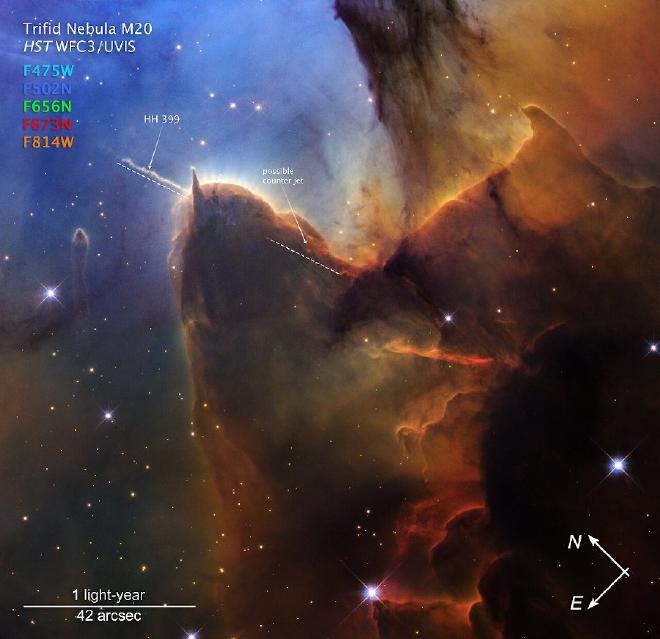
Una región de formación estelar en azul, en la parte superior izquierda, marrón y ámbar desde arriba a la derecha hasta abajo al centro, y negra en la parte inferior derecha. Pequeñas estrellas de color ámbar flotan por todo el recorrido. Hacia la izquierda hay una forma marrón que parece una cabeza con dos cuernos. Una etiqueta, HH 399 jet, marca el cuerno izquierdo. Una segunda etiqueta, posible contra-chorro, marca una zona más roja dentro del ‘cuerpo’ de polvo marrón. Debajo del título hay una clave de colores que muestra qué filtros WFC3 se usaron para crear la imagen y qué color de luz visible se asigna a cada filtro. De arriba a abajo: F475W (azul claro), F502N (azul), F656N (verde), F673N (rojo), F814W (naranja). En la esquina inferior izquierda hay una barra de escala etiquetada como 1 año luz, 42 segundos de arco. La longitud de la barra de escala es aproximadamente una cuarta parte de la imagen. En la parte inferior derecha hay flechas de brújula que indican la orientación de la imagen en el cielo. La flecha este apunta hacia las 7 en punto. La flecha norte apunta hacia las 10 en punto. Crédito de la imagen: NASA, ESA, STScI
El ‘cuerno’ izquierdo del Limón Marino Cósmico forma parte de Herbig-Haro 399, un chorro de plasma expulsado periódicamente durante siglos por una protoestrella joven[^1] incrustada en la cabeza del limón marino. Mira cómo se expande el chorro. Los cambios observados permiten a los investigadores medir la velocidad de los flujos y determinar cuánta energía inyecta la protoestrella en estas regiones. Las mediciones proporcionarán información sobre cómo interactúan las estrellas recién formadas con su entorno.
En la parte inferior derecha inmediata hay evidencia del contrarchorro: líneas dentadas naranjas y rojas que ‘recorren’ la parte trasera del cuello del limón marino, donde aparece una V natural en el polvo marrón.
El ‘cuerno’ más oscuro y triangular a la derecha de la ‘cabeza’ alberga otra estrella joven en su punta. Haz zoom y ves un punto rojo tenue con un pequeño chorro. El arco verde sobre él puede ser evidencia de que un disco circunestelar está siendo erosionado por la intensa luz ultravioleta de estrellas masivas cercanas. Cuanto más clara sea la zona alrededor de esta protoestrella, más clara es la señal de que podría estar casi terminando de formarse.
Los colores de esta imagen del Telescopio Espacial Hubble de la NASA/ESA cuentan una historia sobre la densidad en la Nebulosa Trífida, una región de formación estelar a unos 5000 años luz de la Tierra. La parte superior izquierda, donde es de color azul brillante, tiene la menor cantidad de polvo. Aquí, una poderosa luz ultravioleta despojó los electrones del gas cercano, creando un brillo, y los vientos crearon una burbuja al limpiar el polvo circundante.
Un ejemplo de destrucción activa de nubes se encuentra en la parte superior del área en forma de cabeza con dos ‘cuernos’. Un gas amarillo brillante sube hacia arriba donde se destruye el gas y el polvo.
El polvo más espeso aparece de color marrón oscuro, como barro. En la esquina más a la derecha, que está casi completamente a oscuras, el polvo es el más denso.
Estrellas completamente formadas — orbes naranjas brillantes — están dispersas por la escena. Sus vientos ligeros y estelares también han despejado las zonas inmediatas a su alrededor.
Over millions of years, the gas and dust that make up this nebula (also known as Messier 20 or M20) will disappear and only stars will remain.
Crédito: NASA, ESA, STScI, N. Bartmann (ESA/Hubble). Música:Stellardrone - Ascent
Inmediatamente a la izquierda del Limón Cósmico de Mar hay un pequeño pilar tenue. Gran parte del gas y el polvo de este pilar han sido expulsados, pero el material más denso en la parte superior persiste.
Las nitidez de las estelas y las líneas ofrecen más pistas sobre las actividades de otras jóvenes estrellas. Podemos ver un ejemplo si miramos cerca del centro de una línea ondulante y angulada que comienza en un naranja brillante y termina en un rojo intenso. En la comparación de imágenes, parece moverse, lo que significa que podría ser un chorro lanzado por otra estrella, en formación activa, enterrada profundamente en polvo.
Este episodio de Space Sparks destaca una variedad de imágenes que han aparecido durante el 36.º año de operaciones del Hubble.
En las observaciones de luz visible del Hubble, la vista más clara es hacia la esquina superior izquierda, donde es más azul. La fuerte luz ultravioleta de estrellas masivas, que no estaban en el campo visual, arrancó electrones del gas cercano, creando un resplandor, con vientos que esculpían una burbuja al eliminar el polvo circundante.
En ’la punta de la cabeza’ del Limón del Mar Cósmico, un gas amarillo brillante fluye hacia arriba. Este es un ejemplo de luz ultravioleta que se lanza hacia el polvo marrón oscuro, desmantelando y desbrozando el gas y el polvo.
Muchas crestas y pendientes de material marrón oscuro permanecerán por unos pocos millones de años, a medida que la luz ultravioleta de las estrellas va consumiendo lentamente el gas. Las zonas más densas albergan protoestrellas, que están ocultas por la observación en luz visible.
La zona más a la derecha está casi completamente a oscuras. Aquí es donde el polvo es más denso. Las estrellas que aparecen aquí, en primer plano, pueden no formar parte de esta región de formación estelar: podrían estar más cerca de nosotros.
Este episodio de Space Sparks destaca los descubrimientos científicos publicados durante el 36º año de operaciones del Hubble. Crédito: NASA, ESA, STScI, N. Bartmann (ESA/Hubble), M. Zamani (ESA/Hubble), D. Bodewits (Auburn), J. DePasquale (STScI), B. Balick (Universidad de Washington), G. Anand (STScI) y A. Benítez-Llambay (Univ. de Milán-Bicocca), D. O’Ryan, P. Gómez (Agencia Espacial Europea), R. Crawford (STScI), D. Li (Utoronto), W. Blair (JHU). Música: Stan Dart - Vida Orgánica
Luego, podemos escanear la escena en busca de orbes de un tono naranja brillante. Estas estrellas se han formado por completo, despejando el espacio a su alrededor. A lo largo de millones de años, el gas y el polvo de la nebulosa que la componen desaparecerán — y solo quedarán estos soles.
Longevidad sin precedentes, descubrimientos incesantes
#
Los diferentes instrumentos del Hubble y el amplio rango de luz que recoge —desde el ultravioleta hasta el infrarrojo cercano— han ayudado a los investigadores a realizar descubrimientos revolucionarios durante décadas y a proporcionar a diario nuevos datos que inevitablemente conducirán a más novedades científicas.
“Volemos” a través de la vista, del Telescopio Espacial Hubble de NASA/ESA, de la Nebulosa Trífida . El vídeo “flota” sobre las crestas de gas y polvo y asciende hacia Herbig-Haro 399, en la cima de una nube marrón que parece una cabeza con cuernos.
La línea más delgada e irregular que apunta hacia la izquierda se formó a partir de las eyecciones de una estrella en formación activa.
A su izquierda hay un pilar pequeño y tenue. Gran parte del gas y el polvo de este pilar han sido arrastrados, pero el material más denso en la cima persiste. Crédito: NASA, ESA, STScI, Leah Hustak (STScI), Christian Nieves (STScI). Procesamiento de imágenes: J. DePasquale (STScI), A. Pagano (STScI). Colaboradores: Telescopio Subaru, R. Gentil. Agradecimiento: G. Tocino (STScI), J. Muzerolle (STScI), F. Veranos (STScI)
El telescopio ha realizado más de 1,7 millones de observaciones hasta la fecha. Casi 29.000 astrónomos han publicado artículos científicos revisados por pares utilizando datos del Hubble recogidos a lo largo de los 36 años de vida del telescopio, lo que ha dado lugar a más de 23.000 publicaciones, de las cuales se han realizado casi 1.100 sólo en 2025. Desde 2022, los investigadores han combinado regularmente las observaciones del Hubble con las del Telescopio Espacial James Webb para ampliar las oportunidades de descubrimiento.
El artículo Hubble dazzles with young stars in Trifid Nebula for 36th anniversary fue publicado ayer por la sección de la Agencia Espacial Europea vinculada a la divulgación del Telescopio Espacial Hubble. Especialmente, porque este icónico observador del universo ha llegado a 36 años de servicio… y contando.
Desde Notaspampeanas queremos agradecer al equipo de divulgación de la Agencia Espacial Europea sobre el Hubble, bajo la coordinación de Bethany DownerESA/Hubble Chief Science Communications Officer. Tradujimos el artículo al español, para compartirlo con aquellos interesados que hablan y piensan esta lengua. ¡Muchas gracias ESA-Hubble!