


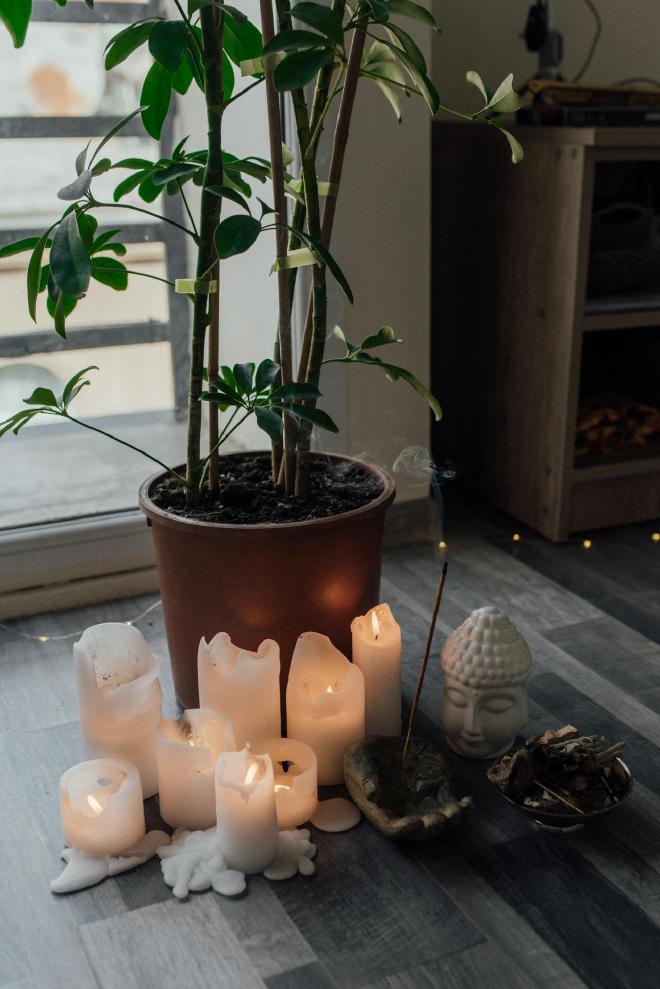
We spend about 90% of our time indoors, where pollutants do not disperse easily and can reach higher concentrations than outdoors, even when the air “seems” clean.
What really happens when we light a candle #
When we light a candle, the wick is not the fuel. Its function is to carry the molten wax to the flame. What actually burns is the wax, which in most commercial candles is paraffin, a petroleum derivative—although it can also be vegetable wax or beeswax.
This combustion process is never completely clean. In addition to carbon dioxide and water vapor, very small particles (PM2.5 and ultrafine particles) and a complex mixture of gaseous pollutants, such as carbon monoxide, formaldehyde, acetaldehyde, and volatile organic compounds(VOCs), are released.
In poorly ventilated indoor spaces, the concentrations of these particles and gases can increase rapidly, reaching values comparable to those in urban environments with poor air quality, especially when combustion is unstable or the wick is too long.
Incense, a source of emissions #
Incense is often perceived as a “natural” alternative to scented candles. However, scientific evidence indicates that its impact on indoor air quality is, in general, greater and more concerning.
During combustion, incense emits large quantities of fine and ultrafine particles, as well as carbon monoxide, nitrogen oxides, and numerous aromatic VOCs.
One particularly relevant finding is that approximately 4.5% of the mass of incense becomes inhalable particles. This is roughly four times more than a cigarette. Thus, incense is one of the main sources of indoor air pollution in non-smoking homes.
Not all particles are the same: oxidative potential #
For years, health risks were assessed primarily based on the mass of particles in the air. Today we know this is insufficient. A key parameter is oxidative potential, which describes the ability of particles to damage our lung tissue.
Candles also emit particles with oxidative activity, especially when they are made of paraffin, are scented, or burn unstably. However, their average oxidative potential is usually lower than that of incense, which generates more reactive aerosols with a greater capacity to induce respiratory oxidative stress.
The role of fragrances: scent complicates chemistry #
The type of wax influences emissions, but it’s not the only factor. Fragrances, both natural and synthetic, introduce new compounds into the cocktail of emitted mixture.
During combustion, many perfumes release reactive VOCs that can transform into other pollutants, such as aldehydes – irritating volatile organic compounds formed by oxidation – and secondary organic aerosols – microscopic particles generated in the air from chemical reactions – increasing both the quantity and reactivity of pollutants present in indoor air.
Thus, a candle marketed as “natural” may cease to be so, from the point of view of air chemistry, if it is intensely perfumed.
Evidence on health effects #
Prolonged exposure to pollutants emitted by candles and incense has been associated with respiratory irritation, worsening of asthma, and decreased lung function, especially in children and people with pre-existing respiratory conditions.
In regions where incense use is daily and prolonged, various epidemiological studies have found associations with chronic respiratory diseases and even lung cancer, reinforcing concerns about this type of domestic exposure.
Which is worse for your health: a candle or incense? #
If both are compared under similar conditions of use, the evidence converges: incense emits a much larger quantity of particles with greater oxidative potential, releases a more complex and reactive gas mixture, and has greater epidemiological support for adverse effects.
This does not mean that candles are harmless, but rather that, generally speaking, incense represents the more aggressive source of indoor air pollution of the two.
Breathing better starts with small gestures #
At home, we often judge the air by its smell or what we see. If it doesn’t smell bad and there’s no smoke in sight, we assume it’s clean. However, the most significant indoor pollution is invisible and accumulates slowly, without warning.
Chemistry reminds us of something essential: well-being is not burned or smelled, it is breathed.
Therefore, reducing exposure doesn’t require sweeping bans, but rather informed and sustainable actions. Using candles and combustion air fresheners only occasionally, limiting their burning time, keeping wicks short and the flame steady, ventilating well during and after use, prioritizing unscented candles, and avoiding the regular use of incense indoors are simple decisions that make a big difference.
Small, everyday changes can significantly reduce the amount of pollutants we inhale. Because caring for indoor air isn’t about sacrificing comfort, but about understanding what we’re breathing and when it’s worthwhile to do so.
Citation #
Author: María Teresa Baeza Romero University Professor. Department of Physical Chemistry. Higher Technical School of Agricultural Engineers of Ciudad Real. Inamol., University of Castilla-La Mancha

This article is a translation of the original, published in The Convesation, in Spanish, authored by María Teresa Baeza Romero, which Notaspampeanas republished today under Creative Commons 4.0
Disclosure statement #
This publication is part of the R&D&I project PID2022-139724OB-I00 funded by MICIU/AEI/10.13039/501100011033 and FEDER, the project SBPLY/23/180225/000194 funded by the Research and Innovation Agency of Castilla-la-Mancha, co-financed by the European Union and the project 2025-GRIN-38334, funded by the UCLM’s own research plan and co-financed with FEDER funds.
Partners #
The University of Castilla-La Mancha provides funding as a member of The Conversation ES.
DOI #
https://doi.org/10.64628/AAO.gkwx4dtqn
Contact [Notaspampeanas](mailto: notaspampeanas@gmail.com)