


“We filter out known natural influences in the observational data, so that the ‘noise’ is reduced, making the underlying long-term warming signal more clearly visible,” Foster added.
Short-term natural fluctuations in global temperature caused by El Niño, volcanic eruptions, and solar cycles can mask changes in the long-term rate of warming. In their data analysis, which is based on measurement data, the two researchers work with five large, established global temperature data sets (NASA, NOAA, HadCRUT, Berkeley Earth, ERA5)
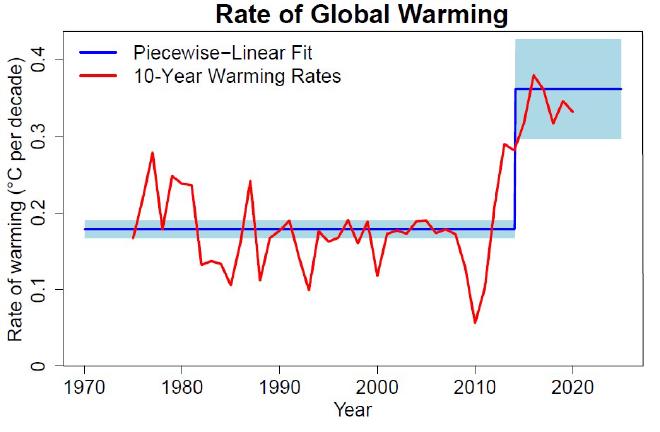
“The adjusted data show an acceleration of global warming since 2015 with a statistical certainty of over 98 percent, consistent across all data sets examined and independent of the analysis method chosen,” explained Stefan Rahmstorf, PIK researcher and lead author of the study.
Study examines statistical acceleration of warming, not its causes #
After correcting for the effects of El Niño and the solar maximum, 2023 and 2024, which were exceptionally warm years, become somewhat cooler, but remain the two warmest years since the beginning of instrumental records. In all datasets, the acceleration begins to become apparent in 2013 or 2014. To test whether the warming rate has changed since the 1970s, the research team applied two statistical approaches: a quadratic trend analysis and a piecewise linear model that objectively determines the timing of any change in the warming rate.
“If the warming rate of the past 10 years continues, it would lead to a long-term exceedance of the 1.5° limit of the Paris Agreement before 2030,” said Stefan Rahmstorf. “How quickly the Earth continues to warm ultimately depends on how rapidly we reduce global CO₂ emissions from fossil fuels to zero."
Citation #
- The study Global Warming Has Accelerated Significantly was published in Geophysical Research Letters. Authors: G. Foster, S. Rahmstorf
Contact [Notaspampeanas](mailto: notaspampeanas@gmail.com)