


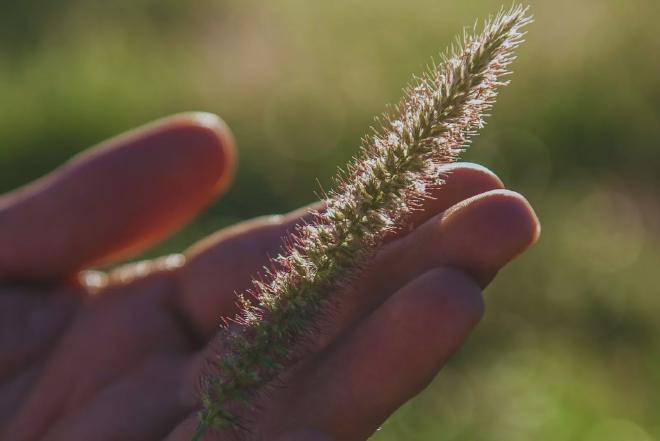
Buffel grass (Cenchrus ciliaris L.) is a perennial grass of African origin, widely used in arid and semi-arid regions due to its ability to adapt to soils and climates with marked lack of rainfall. It is characterized by its resistance to drought, its rapid regrowth and its good forage contribution, which makes it a strategic alternative for the recovery of degraded areas and the sustainability of livestock in this type of environment.
"Buffel grass can become a key tool for producers in the region, as long as it is implemented and managed responsibly," said Héctor Andrada, a researcher at the Rural Extension Agency of INTA Quines, San Luis, Argentina.
According to this, was determined the recommended planting densities (7-8 kilos), the importance of rainfall in the success of the planting, sustainable management such as allowing a growth period to take root, evaluation according to the number of plants per meter and defining their forage use or leaving seed for their correct implantation and subsequent use. This methodology allowed to contrast the yield under management with the accumulated production of the cycle, with the aim of showing the differences in the efficiency of the harvest.

In relation to receptivity, the study applied a parceling model that adjusts the animal load according to forage availability. “This system allows the use of the resource to be optimized, avoiding overgrazing and ensuring the balance between supply and demand,” Andrada explained.
According to technicians evaluation, a successful implementation is achieved with between 8 and 10 plants per square meter, verified the year after planting. Under these conditions, the pasture can produce up to 3,000 kilos of dry matter per hectare, as long as it is managed with adequate rests, moderate load and rotational grazing.
Contact [Notaspampeanas](mailto: notaspampeanas@gmail.com)