


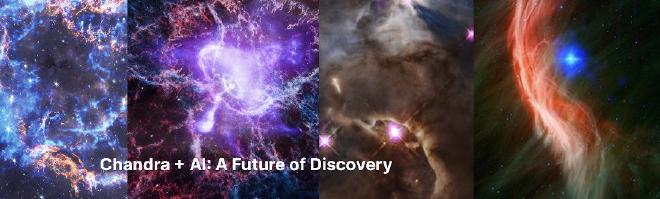
What breakthroughs wait to be found in the vast amounts of Chandra data? #
Artificial Intelligence (AI) tools, especially those based on machine learning, can help scientists using make discoveries by:
-
Finding patterns in huge datasets that might otherwise be missed.
-
Classifying objects like stars, galaxies, black holes, or potentially new classes of objects, based on subtle signals.
-
Speeding up discovery, and making it more efficient, by automating parts of the scientific process.
Glimpses of the future #
-
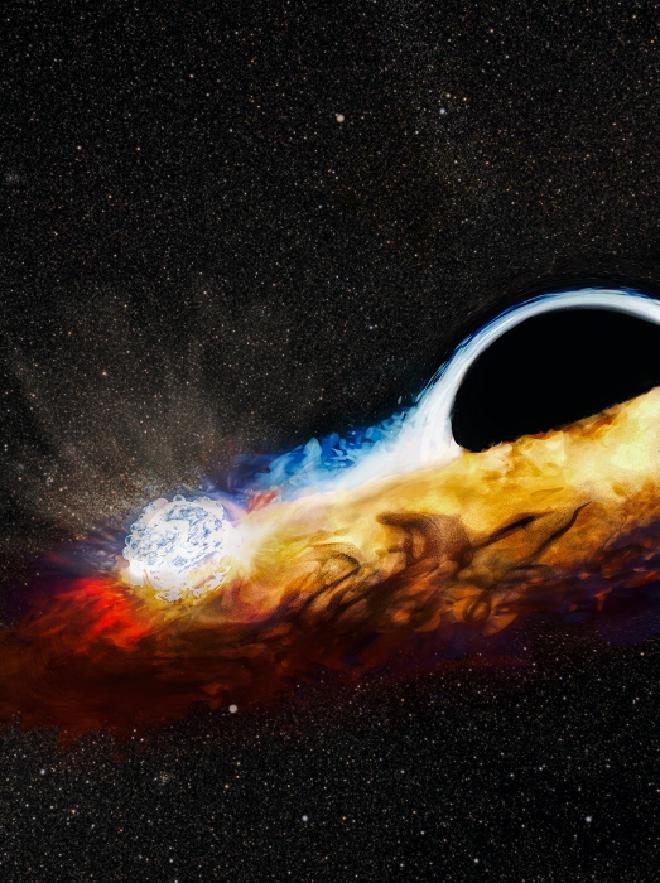
Scientists have trained AI to recognize unique X-ray signatures, find black holes and other intriguing objects.
-
Researchers developed a novel machine learning approach to search for rare high-energy transients in Chandra’s archival data including the discovery of a powerful X-ray flash.
-
AI’s demonstrated ability to detect such fleeting events shows its potential in mining vast astronomical datasets for rare phenomena.
-
Experts are exploring using AI to describe images and to “translate” X-ray data into sound (sonification), making the data more accessible for larger audiences.
Why it matters? #
How will we use the vast collections of data our newest and most powerful telescopes are gathering? With its deep and expertly-constructed archive, NASA’s Chandra X-ray Observatory provides a perfect testbed for using AI to make important discoveries about the cosmos even faster.
The Universe is vast and complex. By combining data from a world-class telescope, Chandra, with the latest in AI, we can unlock mysteries that would have otherwise remained hidden. Let us see where the future can take us.
Contact [Notaspampeanas](mailto: notaspampeanas@gmail.com)