


IPES-Food says that **“far from empowering farmers or tackling climate change, this rapid digital expansion risks increasing farmer debt and accelerating farm loss, deepening ecological harm, and concentrating corporate control over food production. Today IPES-Food published a newest report “Head in the Cloud - Challenging the false promise of digital agriculture and cultivating innovation from the ground up”, that we share here.
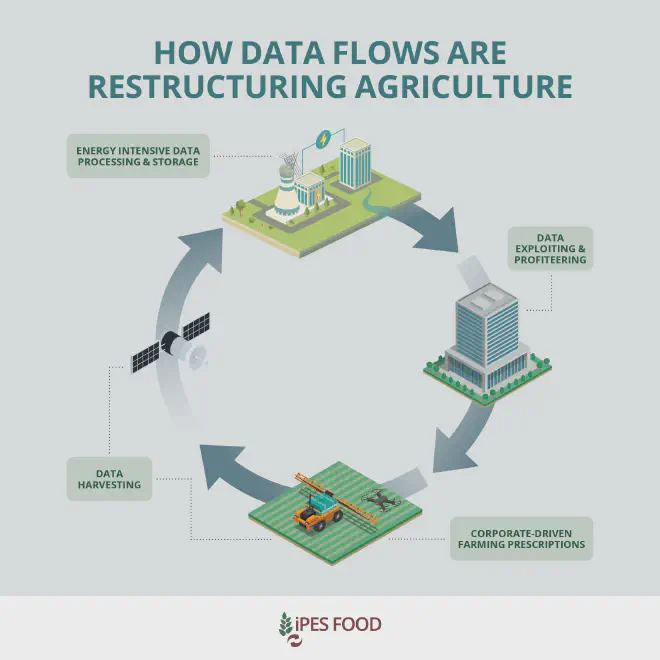
The experts says that Head In The Cloud report examines how this shift is reshaping power in food systems – concentrating control in the hands of major technology and agribusiness firms, increasing farmer dependency, and reinforcing high-cost, high-input production models.
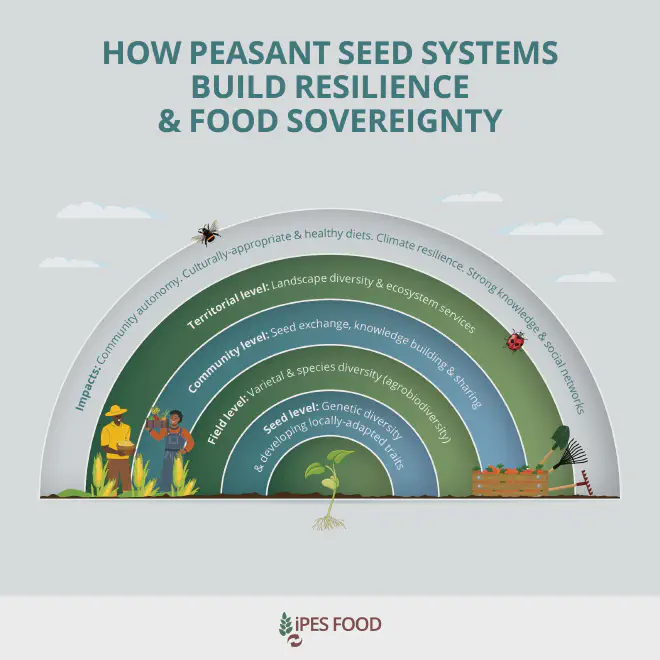
And “at the same time, the report documents farmer-led and community-based innovations that are strengthening soil health, conserving agrobiodiversity, adapting crops to climate change, and building resilient local food systems. These bottom-up approaches prioritize autonomy, ecological sustainability, and knowledge-sharing – yet remain underfunded and marginalized in policy and investment decisions.”
The proposal #
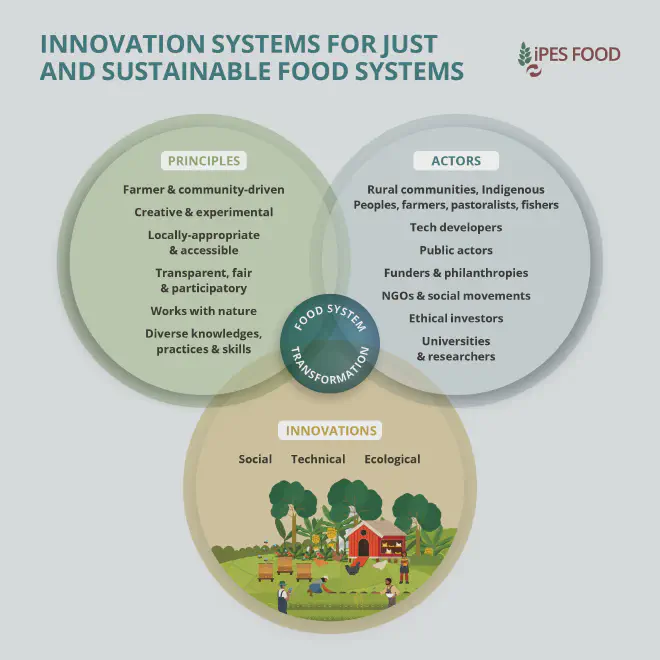
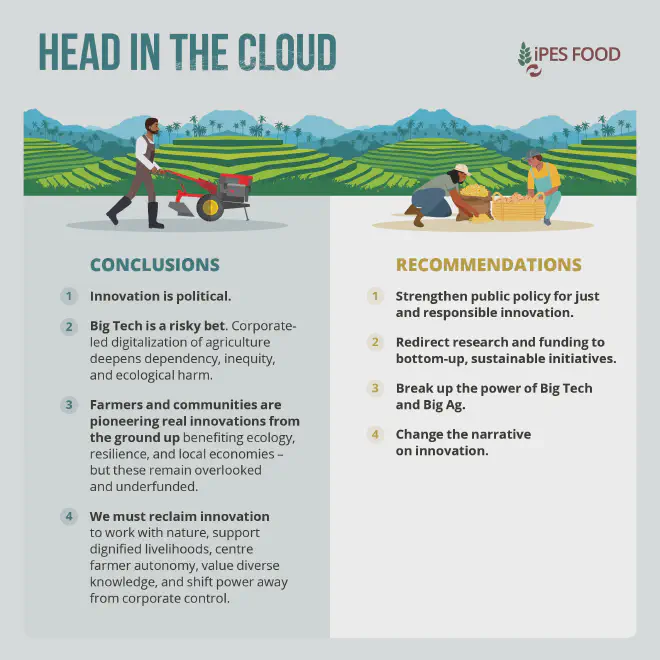
IPES-Food calls for a reorientation of innovation systems to better serve people and the planet:
-
Strengthen public policy for just and responsible innovation.
-
Redirect research and funding to bottom-up, sustainable initiatives.
-
Break up the power of Big Tech and Big Ag.
-
Change the narrative on innovation.
“We are witnessing a quiet takeover of farming by Big Tech. But farming by algorithm is not the future farmers asked for. Under the banner of innovation, tech giants are consolidating control over agriculture and biological heritage, sidelining the farmers who already grow our food in sustainable and resilient ways. We can choose a different path. We must reimagine and govern innovation differently. It’s time to reclaim innovation for people and the planet.”, says Lim Li Ching, IPES-Food co-chair
Meanwhile, Pat Mooney, IPES-Food expert says “the world’s food security is more uncertain than it has been in decades, amid escalating global crises. Yet Big Tech and Big Ag are jointly advancing proprietary AI, data platforms, and biotechnologies that narrow diversity when we need more of it, lengthen supply chains that should be shortened, and concentrate information that ought to be shared among farmers. But our study shows that bottom-up, ecosystem-grounded, farmer-led innovations are already responding to today’s food crises – despite policy barriers and limited public investment.”
And Nettie Wiebe, IPES-Food expert & farmer is sue about “real innovation doesn’t come from Silicon Valley – it comes from farmers, farmworkers, and Indigenous Peoples working with the land and with each other. Around the world, farmers are developing tools, restoring soil fertility, breeding crops for a changing climate, and managing pests ecologically. That’s real innovation. It builds resilience without locking us into debt or dependency.”
“Our research -sustains Yiching Song, IPES-Food expert, shows that farmer-led seed systems and participatory breeding are among the most effective responses to climate change and biodiversity loss. These innovations integrate scientific and farmers’ knowledge, strengthening both ecosystems and livelihoods. If we are serious about climate action, policy and investment must recognise and actively support these systems, not sideline them.”
A summary #
Agricultural innovations are shaped by particular social, ecological, economic, and political systems, and tend to reproduce the paradigms in which they were developed – whether extractive or inclusive, corporate-driven or farmer-led. What counts as innovative, whose knowledge matters, which solutions are considered appropriate, and who should benefit from agricultural innovations are all political choices.
The Big Ones #
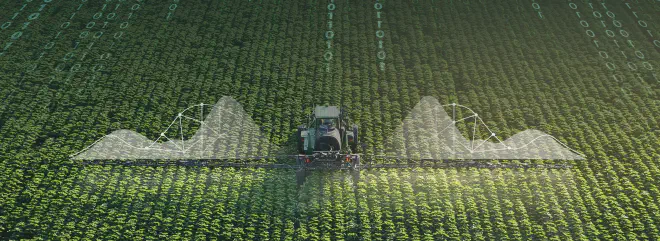
A powerful new alliance between Big Tech corporations (including Google, Microsoft, Amazon, and Alibaba) and Big Ag firms is rapidly gaining control of farming under the guise of innovation. *These Big Tech titans are providing cloud platforms and AI-driven decision tools being integrated into all parts of industrial agriculture, from seeds to chemical inputs to machinery. As a result, they are shaping what technologies are developed, how food production decisions are made, and what the future of farming looks like.
Corporate-led digitalization of agriculture is failing to deliver ecological resilience, equity, or sustainability. Instead, it is deepening dependency on risky corporate schemes and locking agriculture into high-cost, high-energy, and high-input pathways. These innovation models tend to be extractive, expensive, polluting, and misaligned with farmers’ real needs.
Big Tech and Big Ag firms are turning farmers’ knowledge and work into profit, while farmers lose control over their own data. Digitalization is outsourcing farmer decisions to distant algorithms, with little accountability. Control over data is thus becoming a new source of power and profit in agriculture.
Continuing along this pathway risks -adds the IPES-Food report- leaving us with declining ecological resilience, rising farmer debt and bankruptcies, loss of rural jobs, erosion of farmer knowledge and autonomy, widening inequality between farms and between Global North and Global South countries, and shrinking democratic oversight over food systems.
In the other hand #
But #
Innovation systems can and must be reimagined to support just and sustainable food systems. We must talk about, fund, and govern innovation differently. We need to expand what counts as innovation, and shift who drives it, the report states.
As for IPES-Food, reclaiming innovation for people and planet requires: #
-
Strengthening public policy for responsible and just innovation,
-
Channeling research and funding towards sustainable, bottom-up initiatives,
3- Breaking up the power of Big Tech and Big Ag,
- Changing the narrative on innovation.
Innovation can and must empower farmers and serve justice, sustainability, and sovereignty – not deepen dependency.
Download and read the full report #
Contact [Notaspampeanas](mailto: notaspampeanas@gmail.com)