


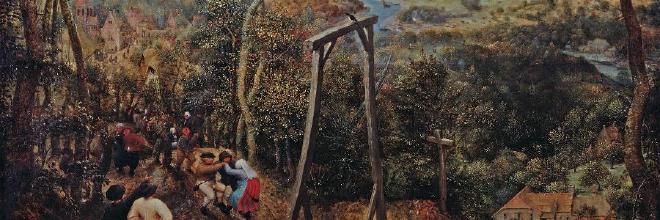
When someone refers to so-called medieval violence or barbarity, they usually talk about the methods the powerful used to administer justice. The death penalty and its various forms are often the prime examples of this. However, the Middle Ages did not invent the death penalty, a procedure that already existed in the Roman world and persisted until relatively recently in Western Europe . In new research published in the book The Gallows and the Fire: A Social History of the Death Penalty in Hispania (700-1200), I attempt to shed light on this topic, which is riddled with clichés thanks to films, literature, and some popular history: witches burned at the stake amidst shouts of jubilation, traitors hanged until their bodies decomposed, or inquisitors eager to condemn to death are some of the recurring scenes. The documented reality is highly nuanced. Because… what do we really know about that era?
Sentences that depended #
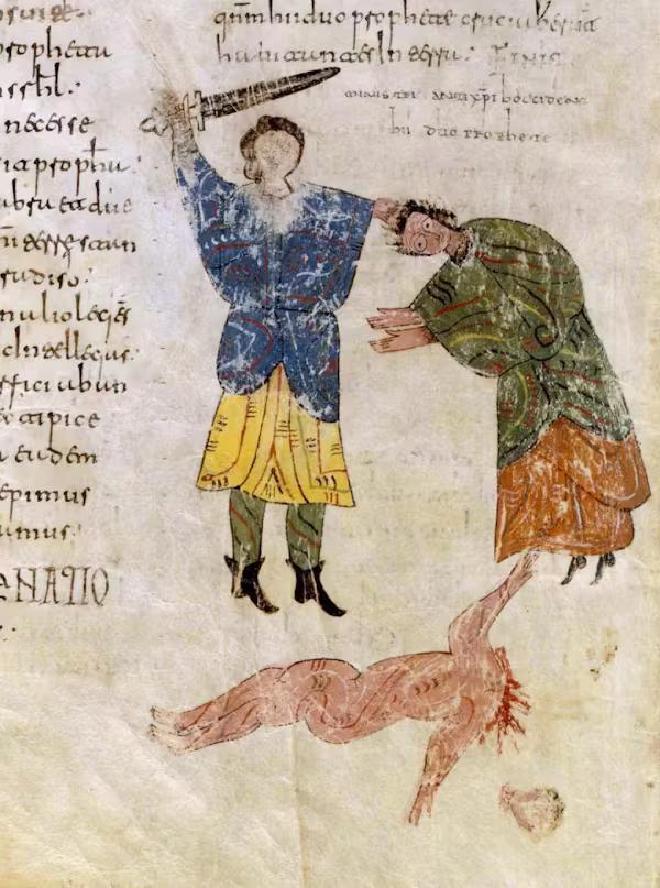
In the High and Late Middle Ages (700-1200), the death penalty in the Iberian kingdoms was a complex practice, and its application was uncommon—furthermore, it is difficult to study due to the scarcity of sources. The most documented methods were hanging, beheading, throwing from cliffs, death by fire, stoning, and drowning at sea, among others. Some methods—such as hanging—are found in specific cases, laws, and even in representations of visual culture, such as capitals or manuscript illuminations. Others, on the contrary, are known only marginally—such as drowning at sea.
The reasons for choosing one form of execution over another depended on the crime committed, the social origin of the accused, their sex, their religious affiliation, or the historical period in which the punishment was carried out. Sometimes proximity to power, even familial power, could be fatal, as demonstrated by executions for treason or rebellion. However, the principle of social discrimination prevailed when money and property could save one from punishment despite threats. Some forms of execution well-known in Central Europe—such as the wheel—were, on the contrary, completely foreign to the Iberian kingdoms.
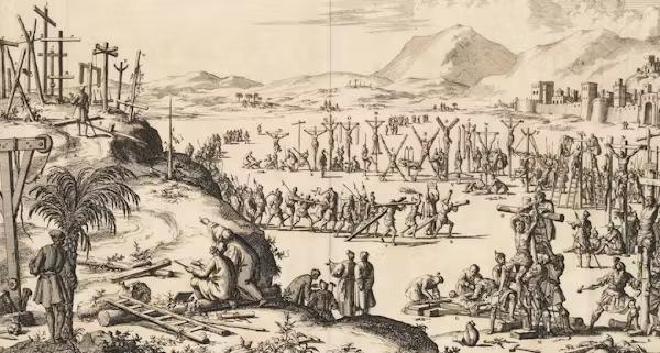
Crucifixion, a type of Roman execution that had fallen into disuse during the spread of Christianity, was still widely practiced in Islamic countries, perhaps as a counterpoint to the taboo surrounding its use in Christian territories. Its message in the Iberian Peninsula presented a unique challenge, as these punishments continued to be used in Andalusian lands while, conversely, they disappeared in the Christian kingdoms. The proximity of these two legal and juridical systems led to a unique relationship in Europe.
It is also surprising that Christianity, Islam, and Judaism all continued to use stoning during the medieval period, even though it is poorly documented. Perhaps its antiquity was a common thread among the three religions, a form of execution that is disputed.
Theological and legal debates #
What is interesting about the early medieval period is the ongoing dialogue between the social and legal structures of the vanished Roman world and the emergence of new societies, new power structures, and economies that did not conform to the imagined past of the classical world. The death penalty was part of these debates: what legitimacy did the ruler or communities have to apply this type of execution, under what authority, and in what cases?
The discussions on this matter were legal in nature and based on theology, specifically biblical principles. Despite the apparent naiveté of Christianity, they could be quite cruel: how could one understand, without the death penalty, the biblical phrase that states that evildoers cannot be spared? Or that “without the shedding of blood there is no forgiveness”? Or also, that “punishing the wicked is not the shedding of blood,” according to Jerome of Stridon?
Examples of death penalties #
It’s also important to remember that under the legal framework of the time, for centuries the lives of thousands of people were cut short for minor offenses (such as theft for survival) and even for reasons that are no longer considered crimes today. These ranged from accusations of witchcraft and heresy to adultery and homosexuality.
For example, in the late 11th century, the father of two daughters who had stolen a cheesecake in Castile was threatened with being thrown off a cliff if he did not compensate for the losses. Similarly, in the late 10th century, around Otero de las Dueñas (in the province of León), a man named Brauolio was involved in an execution for thefts, among other offenses.
Around the year 1100, in Nájera (La Rioja), a woman was threatened with death by fire. The exact reasons are unknown, but they were likely related to religious and sexual motivations, as she had converted from Christianity to Judaism and records show she had several children after her husband’s death. The Navarrese assembly threatened her with this terrible death, and she only escaped by fleeing, despite the efforts of her Jewish community to save her. Records of the search for help and money for her reached as far as Egypt.
In the early 1200s, the case of a woman and a knight executed by fire in León reached Rome. The knight had castrated a clergyman for having an affair with his wife. The king, possibly Alfonso IX, condemned them both to be burned at the stake. Only later, because of his castration, did the clergyman recount the circumstances of his unwanted amputation to the Pope.
Lights and shadows #
All these deaths seem capricious, irrational, and signs of medieval barbarity to us today. But the principles of criminal law and even the types of punishments existed long before and, of course, would last for many more centuries. The death penalty coexisted with the Renaissance, the great scientific revolutions, and even the greatest frivolities of our time. Even recently, Israel has instituted the death penalty by hanging for Palestinians. All of this is a sign that the civilization of our time is not free from the shadows attributed to the past.
It is essential to consider that, while the Gothic cathedral of León was being built, the embers of an execution were cooling not far away. Or that, when magnificent Provençal poetry reached Galicia, blending its love poems with satire, someone was being executed at sea. This mixture of civilization, of high and refined culture with violence, is merely a reminder that history cannot only reveal the rosy side of the past, but also its shadows… like the most beautiful sunsets.
Citation #
- This article is a translation of the Spanish version published in La Conversación. The author is Abel de Lorenzo Rodríguez. Researcher at the Faculty of History specializing in the Middle Ages, University of Santiago de Compostela; University of Edinburgh; Université Paris 1 Panthéon-Sorbonne
DOI https://doi.org/10.64628/AAO.dh7rrdg4h
Disclosure Statement from the author #
This research is part of two research projects: “PADEX Project”, Ref. PID2023-146374NA-I00, funded by the Ministry of Science, Innovation and Universities, MICIU/AEI/10.13039/501100011033/ and the postdoctoral contract and project “E-motion. Dynamics of exiles and forced displacements (Galicia, Iberia and Europe, 8th-13th centuries)”, (ED481B-2024-076), funded by the GAIN Agency, Xunta de Galicia
Universidade de Santiago de Compostela provides funding as a founding partner of The Conversation ES.
The University of Edinburgh provides funding as a member of The Conversation UK.
Université Paris 1 Panthéon-Sorbonne provides funding as a member of The Conversation FR.
Contact [Notaspampeanas](mailto: notaspampeanas@gmail.com)