


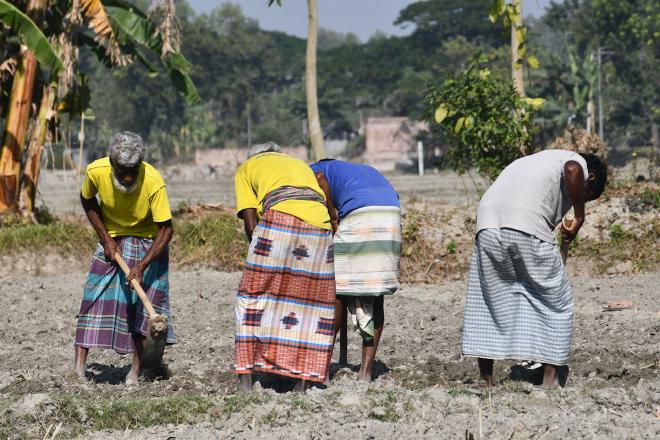
In a new study cited on AGU News, researchers project the increase will affect 28% of the global population overall, concentrated in low-income, tropical nations that have contributed only a small fraction of humanity’s greenhouse gas emissions to date.
AGU News announced the study will appear Tuesday, April 7 in Geophysical Research Letters, AGU’s journal for high-impact, innovative, and timely articles on major advances across the geosciences.
Amplified Extremes #
These extreme combos are already on the rise. When the researchers divided Earth’s land into cells on a grid and compared heat and drought occurrence in each cell, they found that, on geographical average, Earth’s land areas weathered roughly four hot-dry events per year from 2001 to 2020. By their estimates, that’s about twice as often as in the preindustrial period from 1850 to 1900.
To see how conditions might evolve through the end of this century, the team analyzed 152 existing simulations based on eight climate models, considering various scenarios of population growth and global warming outlined in the Sixth Assessment Report by the Intergovernmental Panel on Climate Change. For this study, they defined hot-dry events as days with a high temperature in the top 10% and at least moderate drought, both relative to records from the 1961 to 1990 baseline.
The effort required processing terabytes of data, a significant challenge. “The more chaotic the climate becomes, the more difficult it becomes to make forecasts,” said Monica Ionita, a climatologist at the Alfred Wegener Institute and senior author of the study. “It’s very difficult to keep up with what’s going on now.”
“When you get to almost 30% of the global population affected by this, it’s very critical. It should make us consider much, much more deeply our actions in the future”. Monica Ionita, Alfred Wegener Institute
“When you get to almost 30% of the global population affected by this, it’s very critical. It should make us consider much, much more deeply our actions in the future,” Ionita said. She had anticipated a slightly slower pace of change, ending at a figure of maybe 10% or 15%. “By the end or middle of the century, maybe my children will not be able to experience the life that I have now.”
“By the end or middle of the century, maybe my children will not be able to experience the life that I have now.” Monica Ionita, Alfred Wegener Institute
Some reap what others sow #
However, those who emit the most likely won’t suffer the greatest impacts. According to the geographical distribution of risk in the simulations, low-income nations around the equator and tropics, including islands such as Mauritius and Vanuatu, will feel the most exacerbated hot-dry extremes despite contributing far fewer emissions than wealthier nations. For context, the team estimated the climate impact from the carbon 1.2 average U.S. citizens emit over their lifetimes could expose one additional person to heightened hot-dry extremes by the end of the century.
“For lower-income countries, there is a huge unfairness here,” Cai said. “It’s hard to fund air conditioning. It’s hard to fund health care. There is no backup if water runs out. It’s not just a climate science issue; it is about basic, daily life.”
“It’s not just a climate science issue; it is about basic, daily life” Di Cai, climate cientist from Ocean University of China
“The choices we make today will directly affect the daily lives of billions of people in the future,” Cai said.
For those interested on the study, AGU stated that “the study is under embargo until Tuesday, April 7, 2026 at 13:00 UTC”. The study will be available to view and download at this link after the embargo lifts.
Citation #
- The study “Compound Hot-Dry Extremes Amplify Disproportionate Climate Risks for Low-Income Nations” will be published on April 7 on Geophysical Research Letters, a open access AGU’s journal.
Authors: #
-
Di Cai, Frontier Science Center for Deep Ocean Multispheres and Earth System, Ocean University of China, Qingdao, China; Physical Oceanography Laboratory, Ocean University of China, Qingdao, China; Alfred Wegener Institute Helmholtz Center for Polar and Marine Research, Bremerhaven, Germany
-
Gerrit Lohmann, Alfred Wegener Institute Helmholtz Center for Polar and Marine Research, Bremerhaven, Germany; University of Bremen, Bremen, Germany
-
Xianyao Chen, Frontier Science Center for Deep Ocean Multispheres and Earth System, Ocean University of China, Qingdao, China; Physical Oceanography Laboratory, Ocean University of China, Qingdao, China; Key Laboratory of Transparent Arctic, Ocean University of China, Qingdao, China; Laoshan Laboratory, Qingdao, China
-
Monica Ionita, Alfred Wegener Institute Helmholtz Center for Polar and Marine Research, Bremerhaven, Germany; Stefan cel Mare University of Suceava, Suceava, Romania
-
The article Much of humanity may face hot-dry extremes five times more often by end-century was published on April 4 2026. On Notaspampeanas we republished it citing the original source. You may read our Spanish translation of the article.
Contact [Notaspampeanas](mailto: notaspampeanas@gmail.com)