


  1. Posts/

Archaeological Expedition in Isla de los Estados: a strategic enclave for the Malvinas Islands

·9 mins·
Notaspampeanas
Archaeology Archaeological Expedition Island of the States Malvinas Islands South Atlantic Isla De Los Estados CONICET Here Are Dragons Historical Border Archeology Study Group Institute of Archaeology
Notaspampeanas
Author
Notaspampeanas
Digging on curiosity and science.
Table of Contents

Specialists from CONICET and the University of Buenos Aires carried out the first systematic historical archaeological campaign on the remote Island of the States, a strategic enclave for supply and sovereign projection over the Malvinas Islands during the 19th century. Through the survey of lighthouses, prisons, shipwrecks and ancient settlements, the expedition seeks to reconstruct the primary role that the island played in the consolidation of Argentine borders in the South Atlantic.

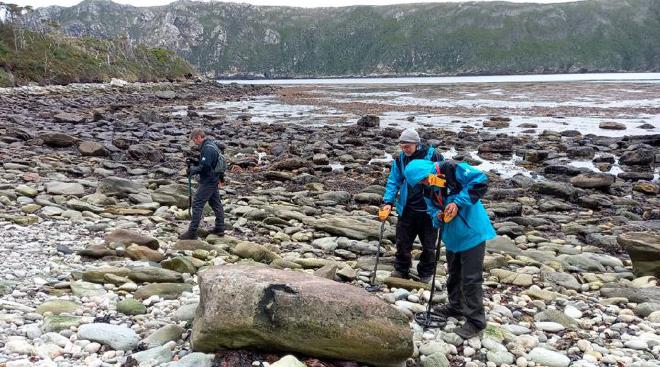
CONICET researchers and fellows carrying out the first systematic historical archaeological campaign on the Isla de los Estados located 230 kilometers from Ushuaia.

Between January 15 and 31, specialists from CONICET, UBA and other institutions and with the support of the Argentine Navy (ARA) carried out the first systematic historical archaeological campaign in one of the most isolated and challenging territories in Argentina: the Isla de los Estados, which can only be reached by navigation through the stormy waters of the Strait of Le Maire. This territory, located 24 km from Tierra del Fuego and 63 km long, contains material vestiges that account for the history of those who consolidated, with their work and presence, the sovereignty of our country in the nineteenth century.

“This campaign carried out within the framework of the ‘Here are Dragons’ expedition and led by the sailor and Malvinas War Veteran Roberto Ulloa, not only seeks to produce scientific knowledge, but also to value the historical heritage of the island, make visible the importance of taking care of its sites, reflect on our maritime history and strengthen memory and sovereignty in the territory,” said Carlos Landa, independent researcher at CONICET and leader of the Historical Border Archeology Study Group of the Institute of Archeology (GEAHF, IA, FFyL-UBA). And he states: Likewise, “the main reason for this scientific mission was to expand information about this island that played a key strategic and economic role in the 19th century, serving as a wood supply base for the Malvinas Islands during the Argentine governorship of Luis Vernet.”

Although archaeological work has been carried out on the island since the beginning of the 1980s, which allowed to date the presence of canoeing peoples three thousand years ago, this is the first campaign that focuses on the human experience after the arrival of Europeans to our continent.

Among other study topics, the team has led archaeological campaigns in forts, battlefields, indigenous settlements and grocery stores. Among them, the one carried out in November 2023 in the Malvinas Islands, under the direction of CONICET researcher Rosana Guber.

Islas de los Estados: strategic enclave for the Malvinas Islands
#

The Isla de los Estados played a key strategic and economic role in the nineteenth century, serving as a supply base for the first Argentine population commanded by Luis Vernet (1791-1871) in the Malvinas Islands. Vernet was the first Argentine political and military commander in the Malvinas Islands and both islands acted as a node of Argentine connectivity in the South Atlantic.

“What motivated us, in the first place, to carry out this campaign on the Isla de los Estados has to do with the research theme carried out by our group of studies of historical archaeology of the border that has to do with the historical past and the human experience in the Malvinas Islands during the nineteenth century, in particular between the Argentine government and the British irruption, especially in the governorship of Vernet,” said Landa.

The Isla de los Estados functioned as an enclave from which timber was extracted for the Malvinas. “For this reason, this island became an interesting point to work from an archaeological point of view, since we have historical documentation from which we can locate sites of interest such as homes, sawmills and several sea lion colonies,” said Sebastián Ávila, a CONICET doctoral fellow at the IA and a member of the team that carried out the archaeological expedition.

“Of course, our interest and attention expanded as we became more aware of the history of the island and its multiple links that also include Captain Piedrabuena, who traded between the Malvinas and Isla de los Estados and a lot of other historical subjects, adventurers and explorers such as Augusto Lasserre, Giacomo Bove, Roberto Payró, Charles Darwin, Robert Fitzroy, Captain John Foster who began to give the island a spatial configuration in cartographies and maps,” said Landa.

The archaeological expedition carried out by Landa, Ávila, Raies and Ciarlo aimed precisely to identify and recover objects such as remains of houses, navigation materials, everyday utensils and possible evidence of commercial exchange that would provide concrete information on how life was organized on the Isla de los Estados and what was its articulation with the Malvinas Islands during the nineteenth century.

“From the crossover between the material findings and the historical documentation on the colony of Luis Vernet and other archives, we are interested in reconstructing supply circuits, labor dynamics and networks of circulation of people and goods in the South Atlantic, and in particular helping to understand the operational link between both islands, that of the States and Malvinas, as a strategic node of connectivity, in a stage of sovereign consolidation in that southern region of our country,” Ávila pointed out.

Archaeological sites explored
#

To reach Isla de los Estados, the archaeology team had the collaboration of the Argentine Navy, the Naval Center and the Military Life Insurance Society.
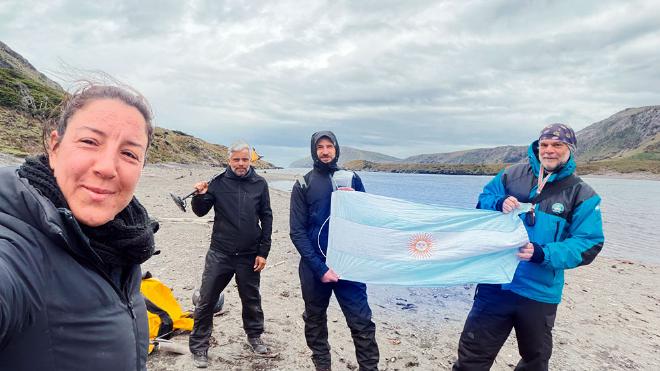
Alejandra Rais, Carlos Landa, Sebastián Ávila and Nicolás Ciarlo, belonging to CONICET and members of the team of the “Here there are Dragons” expedition on the Island of the States
Alejandra Rais, Carlos Landa, Sebastián Ávila and Nicolás Ciarlo, belonging to CONICET and members of the team of the “Here there are Dragons” expedition on the Island of the States.

On two sailboats, the interdisciplinary expedition ‘Here there are dragons’, commanded by war veteran, navigator and writer Roberto Ulloa, took Landa, Ávila, Alejandra Raies, CONICET postdoctoral fellow at IA, and Nicolás Ciarlo, CONICET adjunct researcher and member of the University Institute of Marine Research of the University of Cádiz, in Spain, to Isla de los Estados after sailing through fjords with a very hostile climate and violent Antarctic winds.

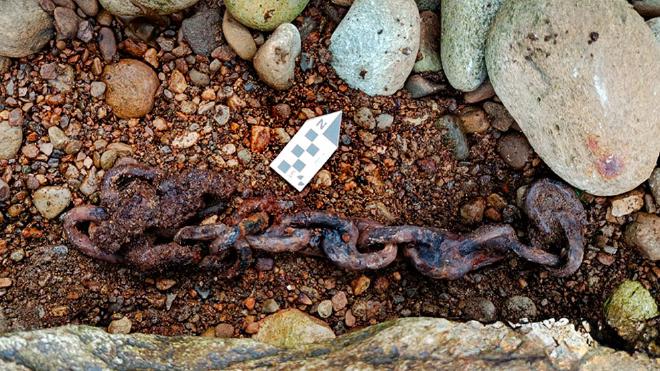
Remains of chains attributable to a shipwreck in San Juan Salvamento.

During the archaeological expedition, the researchers toured the San Juan de Salvamento Lighthouse, an emblematic site of Argentine maritime history inaugurated in 1884, and in which they recorded structures and remains associated with the life of lighthouse keepers and the operation of the so-called ‘Lighthouse of the End of the World’ that inspired Jules Verne’s novel (1905). They also surveyed the vestiges of the Sub-prefecture, a prison and a meteorological station that existed there between 1884 and 1898.

After making measurements and calculations based on the original plans, the researchers were able to verify the original site of the lighthouse and based on that they were also able to determine the place where the orchard and the corral used by the lighthouse keepers were installed. “In the place we found multiple materials, glass, metallic, some referring to food, which speak of the daily life of these people,” said Ávila.

In a context of territorial disputes with Chile, Argentine Navy ships docked in that area in the late nineteenth and early twentieth centuries to support the lighthouse and the presidios that operated on the island, so the investigators identified numerous elements linked to the nautical world.

“In particular, we found a very interesting object, a davit, which is an iron structure that works precisely to raise the boats so that they do not remain in the water and do not hit the rocks in case of a swell or simply to repair them,” says Landa. In that area they also found the structures of the first prison and a barracks for the sailors.
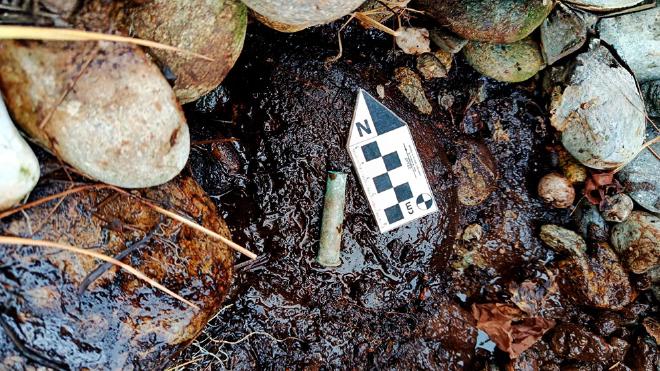
Served Remington 43 caliber case found in San Juan Salvamento.

The first prison on Isla de los Estados was built in the bay of San Juan de Salvamento in 1884, where a military prison operated next to the famous ‘Lighthouse of the End of the World’. But, later he was transferred to Puerto Cook before moving permanently to Ushuaia.

“In history there are multiple cases of the use of prisons and prisons as political and military instruments to settle human settlements and in some way establish a sovereign dominion over different spaces. This is the case of the first prison, close to the ’lighthouse at the end of the world,’” said Ávila.

The research team also surveyed Puerto Cook, the site to which the first prison moved. “At this site we survey structures of the prison that housed more than a hundred inmates and other sites linked to the nineteenth century, documenting evidence of daily life, work and human permanence in an extreme environment,” Landa said. And he added: “We found, for example, Remington cartridge cases, which tell stories of violence in that place.”

Thanks to the comparison of the plans and stilts of various structures, the archaeologists also identified the place where the bakery operated.
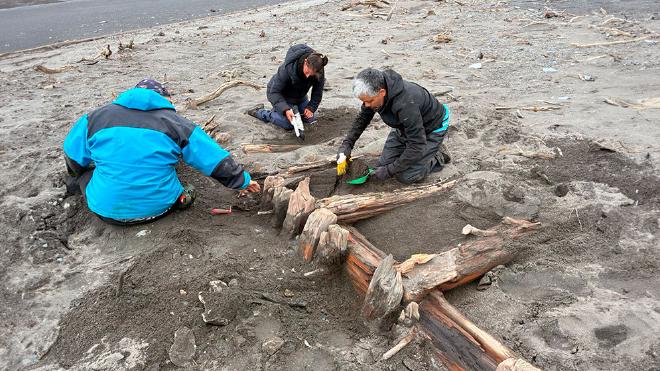
Survey of boat wreckage in Franklin Bay, on Isla de los Estados.

In Franklin Bay, they surveyed shipwrecks and vestiges of human settlements possibly linked to the shipwreck on the island of Luis Piedrabuena (1833-1883) in command of the ship Espora. “This sailor reached the rank of lieutenant colonel in the Navy and his actions helped consolidate the sovereignty of Argentine territory,” Ávila pointed out.

Measurement and sampling records were also made in that area “and a site was found that has an interesting potential to think of as a possible castaway camp, given that there is also material of different types (zinc sheets, wood, glass bottles, and other materials) linked to the second half of the nineteenth century,’ Landa pointed out.

“The total expedition demanded extreme strength and physical and mental preparation,” Landa stated. And he explained: “In addition to the logistics of where we could settle on an island with forested areas, strong winds and intense rains, we had to carry out surveys in different archaeological sites that involved long walks, excavations, climbs and descents through mountains and rocky and slippery beds.”

The food was calculated for three weeks of expedition, but the water ran out and they had to make the island’s water drinkable.

A long-term research and conservation project
#

The results of this expedition, which had the support of the Southern Center for Scientific Research (CADIC-CONICET) and the University of Cádiz, will be the beginning of a broader and long-term research project. “The work done so far is key to future expeditions and conservation efforts. It will also serve to obtain funding that allows for a deeper study of these historic sites,” said Landa.

Likewise, the CONICET researcher highlights that all the information collected (spatial and material data) from this first systematic archaeological campaign on Isla de los Estados requires time to be processed and have results that will give rise to scientific publications, books and other supports that “will shed light not only on the historical link between Isla de los Estados and the Malvinas Islands, but also about the history of the consolidation of our country’s borders.”

Finally, Carlos Landa reflected on the impact of these findings on the understanding of national history: “These works help us understand how those men lived, what they ate, how they dressed, how they survived in such untamed places. And most importantly, they allow us to learn about the first attempts of the Argentine State to establish sovereignty over these islands, a fundamental aspect of our history.”

Contact [Notaspampeanas](mailto: notaspampeanas@gmail.com)


Related

CONICET scientists are making progress in developing a digital diagnostic device for hepatitis E
·6 mins
Notaspampeanas
Hepatitis E CONICET ViroSensAr Network Gisens Biotech INIFTA INQUIMAE INSIBIO MIT Artificial Intelligence Bioelectronics Nanotechnology
FIL researchers discover an energetic “strategy” of the brucellosis bacteria to optimize its multiplication
·5 mins
Notaspampeanas
FIL CONICET Molecular and Cellular Microbiology Laboratory Microbiology Brucella Scientific Reports Mur Fur4
AGGRESCANAI, a software developed to study proteins associated with Alzheimer's, Parkinson's and other neurodegenerative diseases
·3 mins
Notaspampeanas
AggrescanAI Leloir Institute Foundation CONICET Alzheimer Parkinson ELA Neurodegenerative Diseases ITBA Art
A CONICET scientist develops methods to transform waste into biodegradable plastics 'of the future'
·5 mins
Notaspampeanas
Plastics CONICET Chemistry Super-Recycling Plastics of the Future Industry Chemical Plastics Recycling Selective Sequential Recycling
La Pampa: Water Plan 2026-2036 presented by the Governor
·3 mins
Notaspampeanas
La Pampa Water Plan 2026-2036 Water Management Water Resources Use and Conservation Plan 2026-2036
La Pampa: Bacteridian anthrax: preventive measures reinforced and reminder of the importance of vaccination
·2 mins
Notaspampeanas
La Pampa Zoonoses Provincial Board of Zoonoses Bacteridian Anthrax Toay Anthrax