


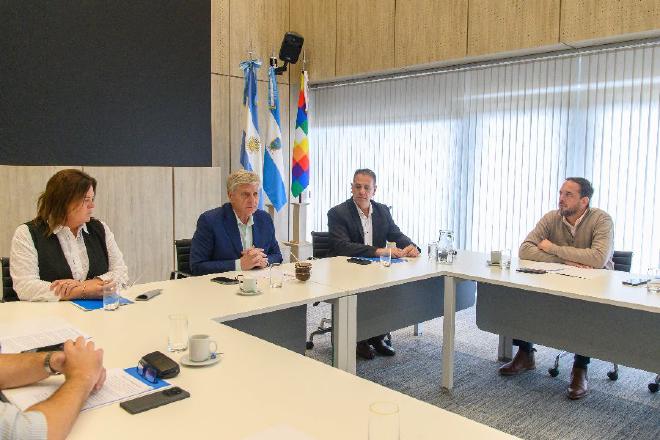
The governor led a working meeting with community leaders representing the ten La Pampas micro-regions, and presented the draft law for the creation of **Road Consortiums **aimed at improving the conservation, maintenance and expansion of the roads of the rural tertiary network.
Ziliotto said that the proposal seeks to consolidate a strategic articulation between the State and the private sector to strengthen rural infrastructure. “Its main strength will be the virtuous partnership and complementarity between the State and the private sector,” he said.
The meeting was attended by: for Region 1, the mayor of Embajador Martini, Ariel Bogino; for Region 2, the mayor of General Pico, Fernanda Alonso, and the mayor of Alta Italia, Hernán Gaggioli; for Region 3, the mayor of La Maruja, Gustavo Cein; for Region 4, the mayor of Algarrobo del Águila, Oscar Gatica; for Region 5, the mayor of Luan Toro, Mónica Valor; for Region 6, the mayor of Santa Rosa, Luciano di Nápoli; for Region 7, the mayor of Anchorena, Gustavo Pérez; for Region 8, the mayor of Puelches, Julio Gerez; for Region 9, the mayor of Alpachiri, Iván Fhur; and for Region 10, the mayor of La Adela, Federico Moro.
The provincial cabinet was represented by the Minister of Government and Municipal Affairs, Pascual Fernández; the Minister of Production, Fernanda González; and the president of the Board of Directors of the Provincial Directorate of Roads, Rodrigo Cadenas. At the meeting, the governor recalled that the initiative responds to proposals made by the agricultural sector within the scope of the Provincial Agricultural Table.
“The law will provide a legal framework for a historical proposal of the productive sector: how to improve the management of the maintenance of neighborhood roads. The proposal is that the private sector can not only make contributions, but also participate in decision-making,” as was revealed.
Ziliotto said that the provincial government is analyzing the possibility of establishing tax incentives for producers who contribute to the maintenance of rural roads through consortiums. “We are studying that those who make contributions can deduct them from provincial taxes through a tax credit system,” he explained.
In addition, Ziliotto indicated that adhesion to the regime will be voluntary for municipalities and development commissions, fully respecting their autonomy. “It is not an obligation to adhere to the law. The resources that municipalities receive today through the decentralization law will continue to be in force,” he said.
In addition, was stated that adhesion to the regime will be voluntary for municipalities and development commissions, fully respecting their autonomy. **“It is not an obligation to adhere to the law. The resources that municipalities receive today through the decentralization law will continue to be in force”, he clarified.
What will the operation be like? #
The draft bill establishes the creation of road consortiums as non-state public law legal entities, made up of rural producers, entities linked to productive activity and local governments. These agencies will have as their main function to execute works of construction, conservation and improvement of rural roads, as well as to carry out complementary works that guarantee the passability of the road network.
The creation of a Fund for Road Consortiums, administered by the Provincial Highway Directorate, is also foreseen, which will be integrated with contributions from the provincial State, municipalities, producers, national and international organizations, as well as donations and other resources.
Contact [Notaspampeanas](mailto: notaspampeanas@gmail.com)