


-
Production as an engine of development: It was highlighted that the only way to generate work, inclusion and development is through production.
-
Tax reduction and subsidized credits: As of April 1st, the new productive credits of Banco de La Pampa will be exempt from Gross Income and Stamps, reducing the cost of financing by 10%.
Specific tax incentives: #
-
Intended for software development and distributed energy, with the possibility of offsetting provincial taxes with salaries.
-
Creation of the Provincial Tax Credit Regime to strengthen technical-professional education.
Support for Pymes and innovation #
- Financing for projects linked to energy transition and productive innovation.
Production parks: #
-
Expansion of the Santa Rosa Food Park.
-
Creation of the Economic Activities Park in General Pico.
Education and Scholarships: #
- Scholarships for university students in companies in the knowledge economy and the ‘Impulse Future’ program for high school graduates.
Economic and Productive Development Plan 2026–2030: #
- Aim for diversification, added value, exports and more employment, with continuity and innovation as pillars.
Energetic System #
- Development in photovoltaic solar parks and distributed generation, with strong participation and public-private systems interaction.
Health and public education: #
Increased investment, with improvements aimed at deepening the quality of education and reducing infant mortality in contrast to the national increase.
Security and Housing #
The governor pointed out that La Pampa is among the safest provinces in the country and maintains inclusive housing policies.
Connectivity: #
Ziliotto highlighted the internet and mobile phone coverage in almost the entire province, with an established goal of reaching 100% by 2027.
Commitment to human rights and historical memory: #
The La Pampa’s governor reaffirmed the maintenance of the historical apothegm ‘Never Again’ in the month that marks a new anniversary of the 50th anniversary of the 1976 coup.
State & Market #
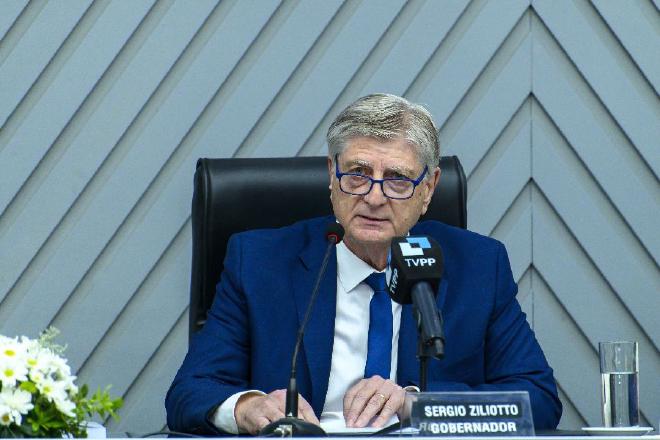
As he has pointed out in other speeches, not only before the Legislature, he pointed out that the axes announced: tax incentives, support for production, investment in education and health, energy and technological development, are under the paradigm: the State and the market must complement each other to guarantee inclusion and growth.
Echoes #
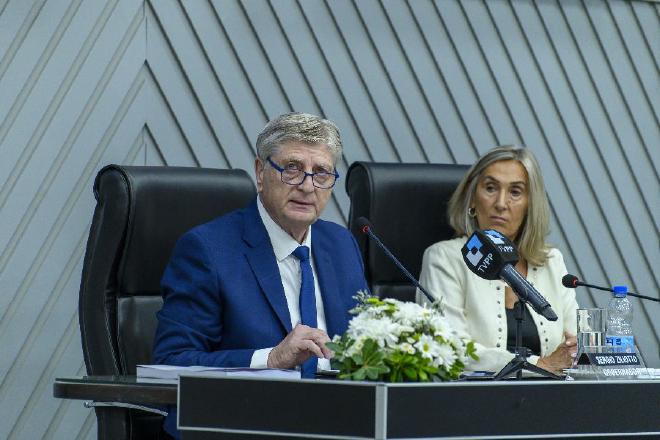
Some observers pointed out that this image would summarize the internal situation in the Pampas PJ. Views that do not coincide between Ziliottism and other internal sectors, such as pure vernism, in the figure of the deputy governor. Image credit: Provincial News AgencySome observers pointed out that this image would summarize the internal situation in the Pampas PJ. Views that do not coincide between Ziliottism and other internal sectors, such as pure vernism, in the figure of the deputy governor. Image credit: Provincial News Agency

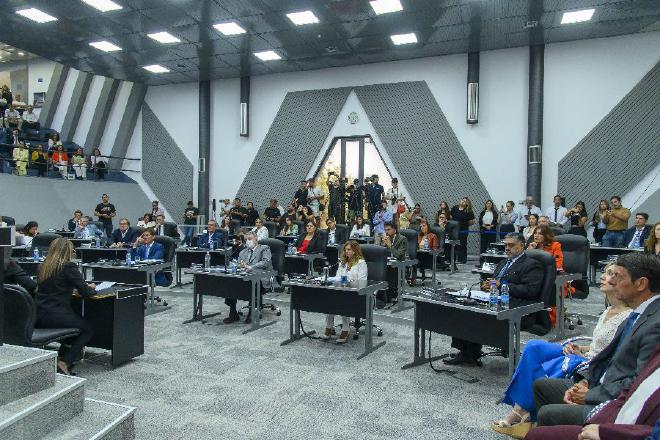
- As expected, in the statements after the speech of the La Pampa’s governor, the bench of provincial government legislators highlighted the battery of tax incentives, support for production, investment in education and health, energy and technological development, under the premise that the State and the market must complement each other to guarantee inclusion and comprehensive growth.
-
In the provincial legislative opposition, some deputies raised doubts about the State’s ability to sustain tax incentives over time and asked for more detail on the implementation of the Tax Credit Regime for technical education.
-
The national legislators of the La Pampa’s PJ, for their part, highlighted the governor’s emphasis on energy transition and innovation, and stressed that articulation with national policies will be key so that solar park and software projects have a real impact.
Ziliottismo / Pampean officialism #
-
They highlighted the objective in production as a central axis.
-
They supported announcements on tax incentives and the 2026–2030 development plan.
-
They underlined the continuity of public policies in health, education and energy.
Vernismo #
-
There was general support for the measures, although with nuances: some of the members of this internal Peronist sector of the Pampas remained in the need for greater fiscal pragmatism and control of execution.
-
They described the speech as a reaffirmation of the unity of the PJ in the face of the opposition.
Other Peronist lines and union sectors close to the government #
-
Sectors of Kirchnerism, La Cámpora and some union sectors coincided with the emphasis on social inclusion and the defense of the present State.
-
It was heard that some lines proposed that the energy and technological agenda should have more participation of cooperatives and social organizations.
Opposition #
UCR #
-
Pointed doubts and questions about the sustainability of the promised tax benefits.
-
They insisted that provincial management depends too much on national resources and argued that there is a lack of transparency in the execution of credits.
La Pampa’s Pro-Macrism #
-
This sector insists on ’excessive state intervention’ and argues that incentives should be broader to attract external private investment.*
-
They consider that the plan announced in the speech is ‘continuist’ and not very innovative in the face of the current provincial economic circumstances, of the Nation, and the insertion of La Pampa in the national and external context.
Ravier’s followers - La Libertad Avanza (LLA pampeana) #
-
They rejected, once again, the model focused mainly on the axis of the present State promoted by the current government.
-
They state that the subsidized credits and exemptions are ‘distortions’ and propose the advance of a total liberalization of the provincial economy.
-
After the last legislative elections, they remarked that LLA consolidated itself as the main opposition force, in which it disputed vote by vote with the PJ the leadership in Santa Rosa and General Pico. They put the emphasis on bringing together the radicalism, the Pro, in next year’s electoral contest to take over the provincial government with the assistance of the political-assistance axis of the political team of the national mileísm.
So? #
In summary, although the PJ appears to be cohesive around Ziliotto, there are internal nuances (Vernismo generates positions and opinions that are opposed to Ziliotto and his team, while Kirchnerism and what has remained of the provincial Camporismo, leans more towards a social axis).
Contact [Notaspampeanas](mailto: notaspampeanas@gmail.com)