


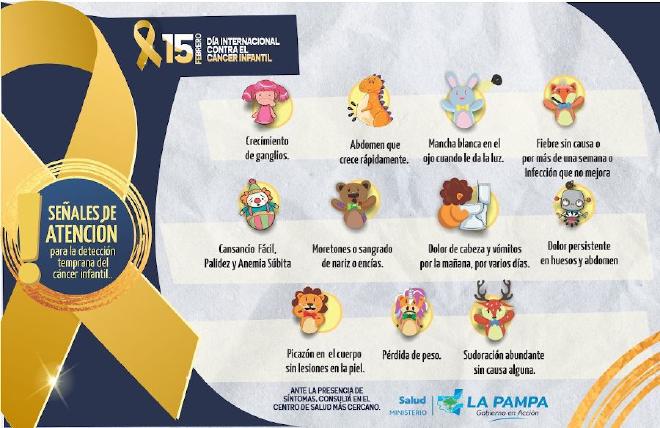
Childhood cancer can be treated with better outcomes when it is addressed quickly and holistically. María Laura Fontanes, head of the Pediatric Oncology Service of the Favaloro-Molas hospital complex, stressed to the Provincial News Agency that every February 15, the world commemorates World Childhood Cancer Day, “a date that reminds us of the importance of raising awareness in society about this disease that affects children and adolescents. Let’s keep in mind that childhood cancer not only impacts the health of the patient, but also the lives of their families.”
Fontanes explained that this disease “appears when the cells of the body, which normally grow and die following a natural order, stop doing so in a controlled manner. Instead of fulfilling their normal cycle, they begin to multiply in an excessive and disorderly way, forming what we know as a malignant tumor. In children, these tumors can originate in different tissues or organs, even in cells that develop from very early stages of life.”
Fundamental #
Early detection of childhood cancer is a decisive factor in increasing the chances of a cure. Although the symptoms are usually similar to those of other common childhood diseases, recognizing them in time allows you to start the appropriate treatment and slow down the progression of the disease. In this regard, Fontanes subscribed that early detection and timely diagnosis are essential to improve prognosis, quality of life and increase the chances of cure. “However, the initial symptoms are often nonspecific and common to other pediatric diseases, which can delay consultation,” she said.
Asked about the warning signs, Fontanes listed that among the symptoms that should draw attention are “persistent fever for more than seven days without apparent cause and that does not respond to treatments, the appearance of bruises in unusual areas such as abdomen, back or arms, unexplained spontaneous bleeding, excessive and sudden night sweats, a notable weight loss in a short period of time despite maintaining the right diet, permanent tiredness for no reason, the presence of palpable masses in the abdomen or other regions. Also enlarged lymph nodes that persist for more than 15 days without diminishing, persistent bone pain that does not subside with common analgesics, pathological fractures in the face of minimal trauma, headaches or intense and persistent headaches accompanied by vomiting and photophobia that constitute a medical emergency, neurological alterations such as changes in gait, difficulty coordinating movements or loss of motor skills. These symptoms do not always mean cancer, but their persistence or particular characteristics should motivate an immediate consultation with the pediatrician. The key is not to underestimate the signs and to act quickly,” she said.
Incidence and most frequent types #
Referring to the provincial reality, she explained that knowing the incidence and the most common types of childhood cancer is essential to measure the challenge and guide care and accompaniment strategies. *“In the Paediatric Oncology Service of the *Favaloro-Molas hospital complex we diagnose an average of between 15 and 20 new cases of childhood cancer per year, which include patients from one month to 15 years of age. For example, in 2024 18 cases were registered and in 2025 there were 10, which reflects the annual variability, but maintains a stable average. The most common tumours in childhood are leukaemias, followed by tumours of the central nervous system and lymphomas. Early detection is key, as between 60 and 70 percent of these cancers are curable when diagnosed and treated early.”
Fontanes said that “worldwide, the most common tumors in pediatrics include leukemias, brain tumors of the central nervous system, neuroblastoma, Wilms tumor, and lymphomas. In general, childhood cancer has a better prognosis, although the emotional and social impact is greater. This is due to several factors: parents are usually more attentive to symptoms, children’s bodies have not received previous treatments and they respond better to therapies. For example, about 80% of childhood leukemias are cured, which is a very high percentage,” she stated.
Interdisciplinary team #
Fontanes valued the joint work carried out in the province of La Pampa, highlighting that behind each diagnosis and treatment there is a committed team that accompanies both patients and their families. “In the Service, I am accompanied by Rosario Jiménez del Toro in oncological clinical support, and we recently incorporated Agustín González Correa, an oncologist at the Garrahan Hospital, who collaborates through telemedicine. In addition, we work with a highly trained nursing team, social service, psychology, infectious diseases, pharmacy in the process of specializing in oncology preparation, nutrition, palliative care and complementary therapies. We also have surgical support for procedures such as catheter placement and general pediatricians who are essential in care. All the members of the team play a fundamental role, because beyond clinical treatment, they accompany each stage of the process providing containment, care, relief and quality of life. These are very complex situations that families go through and we are there to accompany them through them.”
Fontanes concluded pointing out that beyond the commitment and dedication of the work team, “none of this would be possible without an efficient State that prioritizes health, that works and manages constantly to expand and strengthen services in the province of La Pampa. We continue to move forward along these lines, because our priority is always patients and the support of their families. We are part of a committed team that accompanies each process, providing comprehensive and deeply human care.”
Contact [Notaspampeanas](mailto: notaspampeanas@gmail.com)