


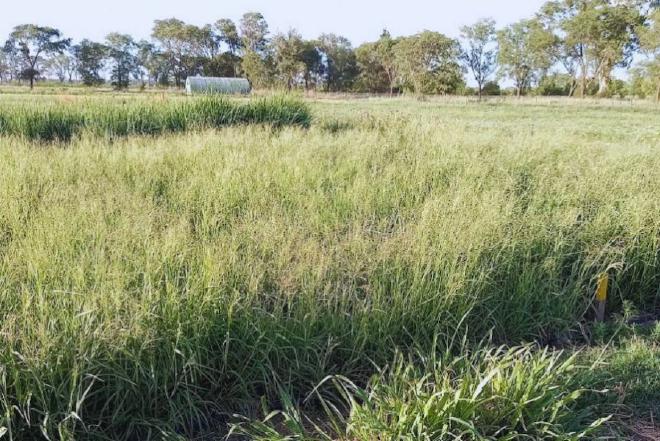
An interdisciplinary research team —made up of specialists from INTA, CONICET and the National University of San Luis— carried out a long-term simulation study to analyze yield gaps and limitations imposed by the availability of water and nitrogen in pastures of Panicum coloratum cv. Klein. This species, widely spread in livestock systems in the center of the country, is valued for its high forage production and its adaptation to conditions of water stress.
The work was based on the Coloratum Model, previously calibrated with field data, with which 40 years of forage production (1979–2019) were simulated under four contrasting scenarios: one with water and nitrogen available in sufficient quantity, another with good water availability but with nitrogen limitations, a third scenario with sufficient nitrogen but with water restriction, and a final case with simultaneous limitations of both remedies.
According to the researcher, in productive terms, the model showed that, when pastures had good availability of water and nitrogen, the average production was 22 tons of dry matter per hectare per year. On the other hand, when both resources were scarce, productivity was reduced to 8 tons, which represents a gap of 64%.
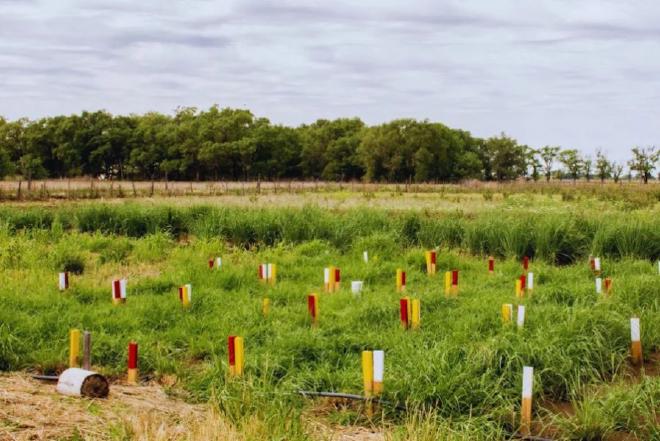
While field tests indicated that water was the main limiting factor — for rainfall below the historical average (436 mm vs. 656 mm) — long-term simulations revealed another picture, she said.
“The model allowed us to see that, on a broad temporal scale, nitrogen explains a greater proportion of the variability in production,” explained Karina Frigerio, a researcher at INTA San Luis. “This has direct implications for management strategies: improving nitrogen availability could significantly close yield gaps.”
Meanwhile, Germán Berone, a specialist at INTA Balcarce, stressed the relevance of simulation models as planning tools. “They help us understand the dynamics of forage systems and project future scenarios in contexts of climate variability,” he said.
Contact [Notaspampeanas](mailto: notaspampeanas@gmail.com)