


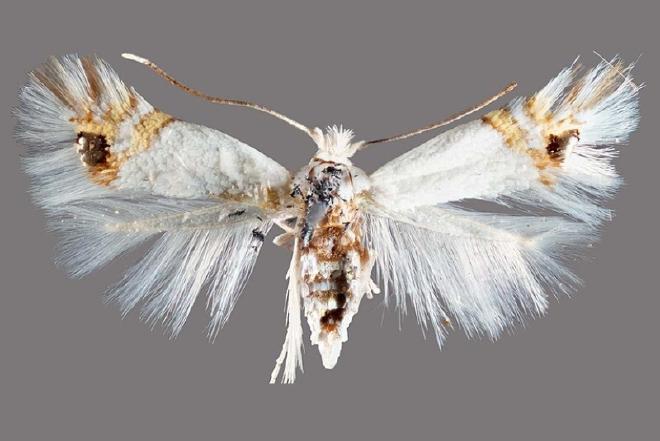
The poplar moth (Leucoptera sinuella) is a leaf-mining pest. Although it affects forest plantations, in recent generations when the larvae complete their development they can affect the fruit trees adjacent to the poplar curtains.
Silvina Garrido, a specialist at INTA Alto Valle, stressed that “the fundamental thing at this stage is to monitor the forest curtains, make a correct identification and communicate quickly to initiate immediate control actions.”
“If the presence of the moth is detected in high areas, which are difficult to access, an application of insecticides should be considered, taking into account the update of the registered insecticides,” the researcher clarified. It is important to note that elimination involves the destruction of detected pupae or larvae.
Harvested fruit #
INTA specialists continue to monitor avenues in the Alto Valle region and emphasize the dissemination of the necessary information for their rapid identification and early management.
How to Identify Poplar Moth #
It should be noted that “adults are small white moths whose first pair of wings has a black spot and three orange stripes. Its larvae mine the inside of the mesophyll of the leaves and its pupae are covered by a white silky cocoon with a very characteristic H-shape,” Garrido said.
What SENASA says #
According to SENASA’s National Pest Surveillance and Monitoring System (Sinavimo), the larvae are small, up to 7 millimeters long, flattened and yellowish-white in color, and feed on the inner tissue of the leaves.
The adult of the Poplar Moth is small, about 3 to 4 millimeters long, with a wingspan of 9 to 10 millimeters; It is bright white with silver scales.
The first pair of wings has the distal end colored with 3 orange stripes and a large black spot on its inner part. Its wings are pointed and have characteristic orange stripes at its ends. The antennae are long, covering almost the entire length of the body.
Contact [Notaspampeanas](mailto: notaspampeanas@gmail.com)