


In recent years, non-invasive sensory stimulation with pulses of intermittent light at low gamma frequency (40 cycles per second or 40 Hz) has become an incipient area of research due to its benefits in people with neurodegenerative diseases such as Alzheimer’s; in the United States, it has already been used experimentally in patients for about five years. However, very little is known about the mechanisms by which such an approach might restore cognitive function. Now, the research groups led by CONICET specialists Alejandro Schinder and Emilio Kropff managed to verify in mice that this intervention leads to the production of new neurons in the hippocampus – the area where memory is stored – of aging brains.
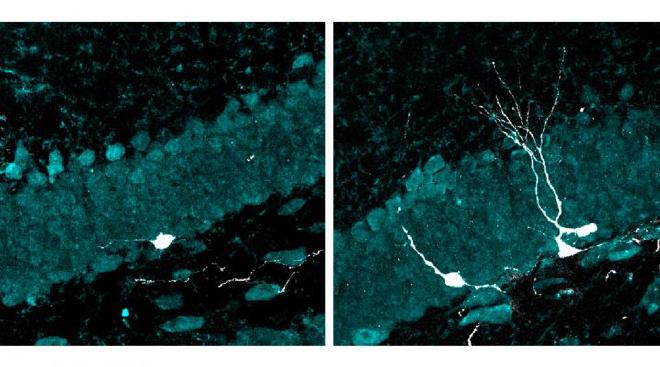
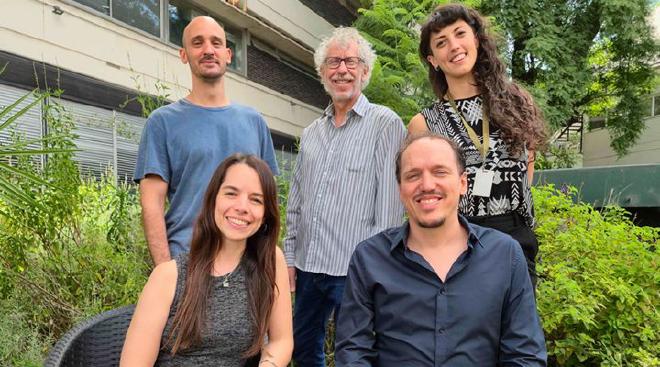
“These new neurons also showed a more advanced development than those of the animals in the control group: they grew more, formed dendrites and more complex axons (the input and output wires of neurons) and established more effective connections with the rest of the circuit,” highlighted CONICET researcher Mariela Trinchero, lead author of the study together with Magalí Herrero, a doctoral fellow at CONICET, both members of the Institute of Biochemical Research of Buenos Aires (IIBBA, CONICET-FIL) and the Neuronal Plasticity Laboratory led by Schinder at the *Leloir Institute Foundation (FIL).
Trinchero added that another key finding they made was to prove that the combination of light and sound is essential. “When the stimuli were applied separately, the effects were partial. Synchronized multisensory stimulation showed synergy in the effects on the structure and function of neurons,” she said.
Why is it that if they are applied at the same time it is better than each one on their own? “The reason for this synergy in stimuli is one of the many things that we still have to elucidate about this treatment,” Schinder emphasized.
Strengthening neural circuits #
It is known that in Alzheimer’s patients, gamma oscillations are affected. In 2016, a group of MIT scientists published a pioneering paper in the journal Nature: they showed that a non-invasive regime of flickering light at 40 Hz reduced the load of amyloid plaques (abnormal deposits of the beta-amyloid protein that accumulate between neurons), considered key markers for the development of Alzheimer’s disease, in mice.
From that moment on, the race began to determine whether intermittent light stimuli at that rate of the gamma band could produce therapeutic effects. Thus, various studies around the world have provided evidence, in animal models and more recently in humans, that it is a safe method that helps to alleviate the symptoms, for now experimentally, of Alzheimer’s pathology and its consequences.
“From the new study we were also able to identify that the effects of audiovisual stimulation depend on signals that promote neuronal growth, in particular on the activation of a receptor called TrkB, known for its central role in neuronal plasticity,” Trinchero said.
“The work contributes to closing a key gap between ongoing clinical trials and the basic understanding of their effects, and could lay the groundwork for the future design of clinical studies also in Latin America, with non-invasive and potentially accessible strategies,” Schinder said, who emphasizes that the study of fundamental mechanisms of the aging brain is a long-term investment: “Understanding how neuronal plasticity works is an indispensable step to generate future strategies that promote healthy aging and prevent or treat neurodegenerative diseases. Without that basic knowledge, the second would be impossible.”
Citation #
- The study Audiovisual gamma stimulation restores hippocampal neurogenesis and neural circuit plasticity in aging mice was published in Molecular Psychiatry, from Nature’s group. Authors: Mariela F. Trinchero, Magalí Herrero, Matías Mugnaini, Natalia Soldi, Andrea Aguilar-Arredondo, Sabrina Benas, Ignacio G. Satorre, Emilio Kropff & Alejandro F. Schinder.
Acknowledgements #
The researchers stated: We thank members of the AFS. and EK labs for insightful discussions, Agostina Miranda and Juan Simón Serrangeli for data collection (Figs. 1C, 2H and S7). MFT, EK and AFS are investigators at the Consejo Nacional de Investigaciones Cientificas y Tecnicas (CONICET). MH, MM, NS and SB were supported by CONICET fellowships.
Funding #
National Institute of Neurological Disorders and Stroke and Fogarty International Center grant R01NS103758 (AFS). Argentine Agency for the Promotion of Science and Technology grant PICT-2020-0046 (AFS). Argentine Agency for the Promotion of Science and Technology grant PICT-2021-0077 (AFS). Argentine Agency for the Promotion of Science and Technology grant PICT-2021-00257 (MFT). Argentine Agency for the Promotion of Science and Technology grant PICT-2019-2596 (EK).
- The article Estudio preclínico: la estimulación con luz y sonido intermitentes promueve el desarrollo de nuevas neuronas en cerebros envejecidos was published on the websites of Fundación Instituto Leloir and on CONICET.
Contact [Notaspampeanas](mailto: notaspampeanas@gmail.com)