


  1. Posts/

Ticking time bomb: Some US farmers report as many as 70 tick encounters over a 6-month period

·5 mins·
Notaspampeanas
Ticks Animals Invertebrates Arthropods Arachnids Lyme Desease Bacterial Infections Microbial Infections Infectious Deseases Agriculture Farming Conventional Farming
Notaspampeanas
Author
Notaspampeanas
Digging on curiosity and science.
Table of Contents

Finding one tick on your body is scary enough – tick-borne diseases are serious – but what if you found more than 10 on yourself in just one month? That’s the plight of some farmers as the threat of ticks and tick-borne diseases grows, according to new research featuring experts at Binghamton University, State University of New York.

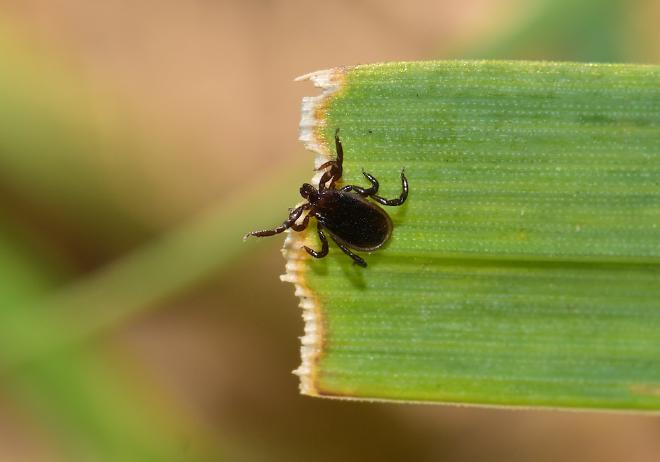
Some outdoor workers reported as many as 70 tick encounters over a 6-month period, according to new research led by Binghamton’s Tick-borne Disease Center. Image Credit: Photo by Pablo Tapia Ossa via iNaturalist. Some rights reserved (CC-BY-NC)
Some outdoor workers reported as many as 70 tick encounters over a 6-month period, according to new research led by Binghamton’s Tick-borne Disease Center. Image Credit: Photo by Pablo Tapia Ossa via iNaturalist. Some rights reserved (CC-BY-NC).

John Brhel wrote that a new research led by Mandy Roome, associate director of the Tick-borne Disease Center at Binghamton University**, **State University of New York, reveals that farmers and outdoor workers in the U.S. Northeast are facing an escalating threat of tick-borne diseases, which could be devastating to their livelihoods.

Ticks are surging and spreading throughout the United States, causing alarm for all who fall within their path, especially those in the Northeast ot the country. Farmers, who spend a substantial amount of time outdoors, in habitats ideal for ticks, face an even greater threat.

The article cites what happened in the past, and now, with ticks en the USA. “Not much has been done in the Northeast United States with outdoor workers and tick-borne diseases since the early 90s,” said Roome. “Ticks and tick-borne diseases were a very different risk in the early 90s than they are now. We wanted to figure out how we can help some of our most vulnerable workers.”

Roome and her team connected with 53 individuals, representing a total of 46 farms in Southern Vermont, an area chosen for its high incidence rates of Lyme disease, high level of agricultural activity and abundance of tick habitats. The questionnaire collected data on tick bites, health history, prevention practices, farm activities and more.

“As you would imagine, tick encounters are generally higher than what we see for ourselves,” said Roome. “Some of them, especially if they’re doing something like fence repair in the spring, they’re inundated with ticks, unfortunately. So we wanted to try and identify something quick and easy for them. And we talked about different farm activities: mowing, plowing the fields, mowing the lawn around the farmhouse.”

The results
#

The survey revealed some surprising results:

  • 12% of respondents reported ever being diagnosed with a tick-borne disease

  • Over the previous 6 months, participants reported an average of three tick encounters

  • Some workers reported as many as 70 encounters

  • There was a marginal association between grazing livestock and increased tick sightings

“Anyone who’s had a tick-borne disease before, or who knows someone who has – whether it was a fellow farmer, or someone in their family – they kind of notice how debilitating it can be,” said Roome. “They have a lot of priorities on a farm. They’ve got a lot to deal with to run a farm like that, but that’s kind of something that’s always in the back of their minds.”

From bites to major surgery
#

One farmer in the study had contracted Lyme carditis, a serious bacterial infection of the heart, for which he eventually needed to have open-heart surgery.

“These are the things that we would like to prevent,” said Roome. “For anybody that’s detrimental. But especially for a farmer, not being able to do that work can have massive consequences on the whole farm.”

The research led by Roome is part of a larger project aimed at testing an environmental intervention. Roome and her team are trialing tick control tubes that will help kill ticks on mice, which are the number-one reservoir for transmitting pathogens to humans.

“We’re trying to identify something effective and easy for farmers to do. Any outdoor worker, you’re in tick habitat. So ‘avoid tick habitats’ is really not the solution for them,” concluded Roome.

Citation
#

  • The paper, “Ticking Time Bomb: The Escalating Threat of Tick-Borne Diseases in Rural Farming Communities,” was published in the Journal of Agromedicine. Authors: Amanda Roome, Destiny Trombley, Megan Kern, Melissa Scribani, Paul Jenkins, Richard Ostfeld & Julie Sorensen.
NdelT.: I took this article from Binghamton University, State University of New York, because the spread of ticks and their ability to ‘dive’ into the human body is associated with red deers, for example from the Rocky Mountains in the United States. In Luro Park, a nature reserve in the province of La Pampa, Argentina, where there are deer introduced from Europe, there are ticks. I know of the case of someone who, upon returning from Luro Park, found that a tick had inserted its head and part of its trunk into his body. He went to a public health center where they ‘removed’ it by burning the tick with a lighter. Ten days later the person developed weakness and fever. He attended a private health center; He told the doctor on duty what had happened. The professional indicated that she should inform Public Health, because incidents with ticks must be reported. The truth is that the diseases associated with the actions of ticks, which also affect dogs and cats, are not publicly disseminated. The person recovered, although he has the effects of the encounter with ticks on his body. There are also known cases in which ticks lodge in the hair of people of different ages, and they were discovered by nurses who carefully checked the hair until they found these dangerous arthropods. In some patients they had already affected the body almost to the heart area.

Contact [Notaspampeanas](mailto: notaspampeanas@gmail.com)


Related

Biodiversity strengthens pollinators and ensures stable yields
·3 mins
Notaspampeanas
Plant Ecology Animal Ecology Agriculture Applied Ecology Biodiversity Pollinators Sunflowers University of Würzburg
New function of a protein revealed that could be useful for applications in agriculture and oncology
·6 mins
Notaspampeanas
CONICET Institute Leloir Foundation PRMT5 Protein Agriculture Oncology Genetic Plant Development Laboratory Biochemical Research Cancer
Buffel grass: a forage alternative to recover degraded areas
·3 mins
Notaspampeanas
INTA Buffel Grass Degraded Areas Forage Agriculture INTA Quines
Genetic engineering: improving biofertilizers to increase soybean productivity
·4 mins
Notaspampeanas
Genetic Engineering Biofertilizers Soybean Productivity Rhizobia Agriculture Agronomy CONICET IABIMO INTA
Sunspot Drawings Illuminate 400 Years of Solar Activity
·5 mins
Notaspampeanas
Heliophysics Sun Sunspots Drawings Andrés Muñoz-Jaramillo Hisashi Hayakawa
EPFL and Johns Hopkins are cracking the code for prostate cancer
·3 mins
Notaspampeanas
Prostate Cancer Castration-Resistant Prostate Cancer CRPC Androgen Receptos Epigenetics KMT2D Chromatin Remodelling Stem Cell-Like Subtype Therapy Resistance Targeted Therapy Single-Cell Sequencing Organoids Genetically Engineered Cell Lines Preclinical Models Transcription Factors