


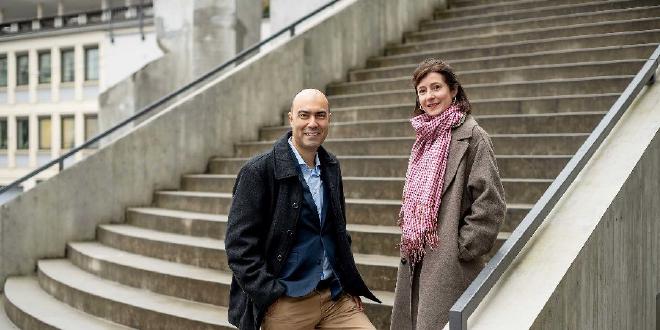
Nestled somewhere in the mountains of Colombia, there might lie a powerful weapon against Alzheimer’s, states and article signed by **Samuel Schlaefli**, freelance author. Francisco Lopera was sure of it. Lopera, a neuroscientist, who passed away in 2024, spent 40 years working with the residents of a village not far from the metropolis of Medellín. Here, thousands of residents live with a genetic mutation that causes them to develop Alzheimer’s at an early age, usually between 45 and 50, followed by the familiar progression: memory loss, problems with orientation and mobility.
The link between Alzheimer’s and sleep #
Neuroscientist Caroline Lustenberger first read about Lopera’s cohort in an article in Nature in 2019. Group leader at the ETH Chair of Neuronal Movement Control, she is best known for her research on sleep, having led the sleep laboratory at the Department of Health Sciences and Technology (D-HEST) at ETH Zurich since 2019. It was no coincidence that she began to take an interest in Alzheimer’s a few years ago. “In its early stages, Alzheimer’s affects regions deep in the brain that play a key role in sleep, arousal, and regulating our metabolism,” says the researcher.
Together with neuroscientist Rafael Polanía, Lustenberger has developed a method for assessing the risk of Alzheimer’s ten to twenty years before the first symptoms manifest. Polanía worked as a professor of decision neuroscience at ETH Zurich from 2018 to 2024. He went on to found the ETH spin-off Herencia Solutions AG together with Lustenberger and now devotes himself to the enterprise full-time.
It’s possible to detect Alzheimer with a smartphone? #
“To diagnose Alzheimer’s, we record pupil movements under specific conditions because they are our window onto the brain,” explained Lustenberger. Currently, this requires a laptop and an eye-tracker. In the future, though, eye tracking could also be done using a smartphone. This would make early detection of Alzheimer’s more accessible and would allow people to do it from the comfort of their own home – making it available even in low-income countries, where experts expect to see the greatest increase in Alzheimer’s in the future. “We’ve filed a patent for our method, which is one of the first digital biomarkers that allows for an early and globally scalable assessment of a person’s risk of developing Alzheimer’s,” said Lustenberger. The aim is to build a bridge from diagnosis to future therapies.
“A few weeks later, I was flying out to pitch Francisco our method for early Alzheimer’s diagnosis,” recalls Polanía. “Francisco was convinced that Alzheimer’s research should focus more on early detection and prevention.” Which is why he recognised the great potential in the spin-off’s approach. Since that first meeting in Medellín five years ago, Polanía and Lustenberger have been working closely with the neuroscience group at the University of Antioquia to test and further develop their early detection method with this unique Colombian cohort.
Tripling of Alzheimer’s patients by 2050 #
We can’t be surprised by some numbers: How many human beans are living now in Eart? More than 7.000? So so. ¿How many of them - us - are dealing with deseases?
“It’s like an avalanche: you don’t see the damage until it’s too late,” stated Lustenberger. It’s one of the reasons previous clinical trials that pharmaceutical companies have conducted for Alzheimer’s therapies have been unsuccessful. By the time treatment begins, the damage to the brain is usually already too far gone. “We want to intervene long before the first signs of damage become visible,” says Lustenberger.
Why Colombia? #
Lopera wanted to get to the bottom of things -wrote Samuel Schlaefli- and to conduct an autopsy on her brain for research purposes. For the strictly Catholic family, that was initially out of the question. “He got down on his knees and begged the family, in the name of Alzheimer’s research, to allow him to examine her brain,” remember Polanía. “Francisco was convinced that her brain was the key to a possible therapy.”
Working with researchers from Harvard University, Lopera ultimately identified a total of three gene variants in Aliria’s genome and the genome of other relatives that protected them against Alzheimer’s.
Social inclusion for those living with Alzheimer’s #
Which is why, several years ago, the research group in Medellín devised a programme whereby family members are supported among others, via caregiving programs, while at the same time receiving professional carer training at the university. This training is intended to secure the families’ livelihood once their relatives have passed away. To ensure these sorts of social programmes can be maintained long-term, the research team is currently setting up a charitable foundation which will have family members and other affected individuals from the community on its management team.
Care and research a stone’s throw from the city #
The location of the integrated research and care village for people living with Alzheimer’s has already been chosen, with the University of Antioquia providing a 130,000 m2 plot of land on the outskirts of Medellín. Lustenberger and Polanía are currently seeking investors and philanthropists for the first phase, with planned investments of ten million Swiss francs. At the same time, the first centre for people with Alzheimer’s is being set up in Medellín, a kind of satellite of Villa Aliria.
Contact [Notaspampeanas](mailto: notaspampeanas@gmail.com)