


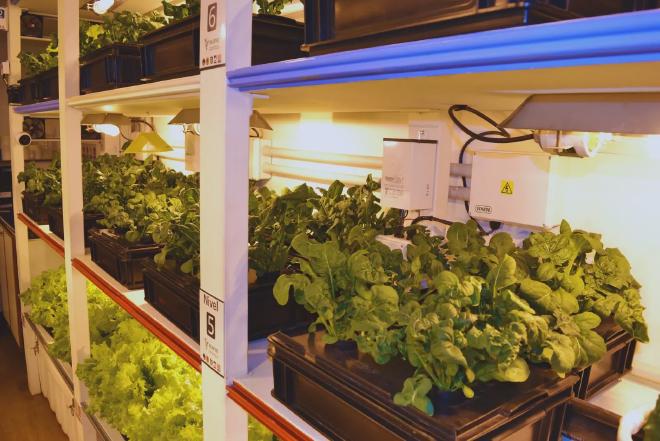
Both institution are working on the development of a module that facilitates the production of vegetables under variable climatic conditions in small spaces. The aim is for the final prototype to be economically accessible and for anyone in the household to be able to use it.
The project is based on the experience in the development of the Antarctic Hydroponic Production Module (MAPHI), designed to produce vegetables in extreme conditions in Antarctica. Based on this know-how, INTA Santa Cruz, in coordination with the National University of La Matanza, proposed to adapt and optimize this technology on a smaller scale, aimed at domestic use.
The initial objective was to transform a highly complex system, designed for hostile and isolated environments, into a compact, efficient and economically accessible prototype, capable of producing fresh food in small spaces and under variable climatic conditions.
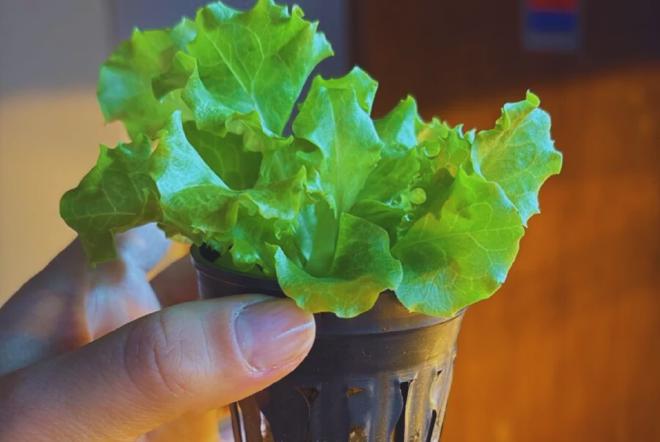
Meanwhile, Martín Díaz, director of the project that is advancing in the optimization of the module, stressed that “from this articulation, technical tools will be contributed that nourish this prototype and allow us to achieve the objective of achieving a product that can be marketed.”
In the experience in Antarctica, the MAPHI project led to the development of a technology package that includes a series of compatible substrates, a type of seed, a treatment and a protocol for these seeds.
At this stage, work is being done so that MAPHI technologies become a product that is used by society and the productive sector. In other words, the project that was consolidated by producing vegetables in Antarctica under extreme conditions is intended to serve as a springboard to generate commercial products.

Birgi pointed out that “to achieve this goal, the MAPHI team developed a prototype of the module of reduced size that incorporates new functionalities that facilitate its use in a home environment.”
Through the joint project, INTA and UNLAM will provide a business plan to convert the prototype developed by the Santa Cruz Experimental Station into a commercial product. In this line of work, a market study will be carried out to define the population interested in taking advantage of it and an intuitive interface so that the module can be operated through an application for mobile phones.
The proposal is part of the Technological and Social Development Project (PDTS) call, a joint initiative of the National Interuniversity Council (CIN) and the European Union (UNIUEAR).
Citation #
- The article Desarrollan un módulo hidropónico para producir vegetales en espacios reducidos was published on INTA Informa
Contact [Notaspampeanas](mailto: notaspampeanas@gmail.com)