


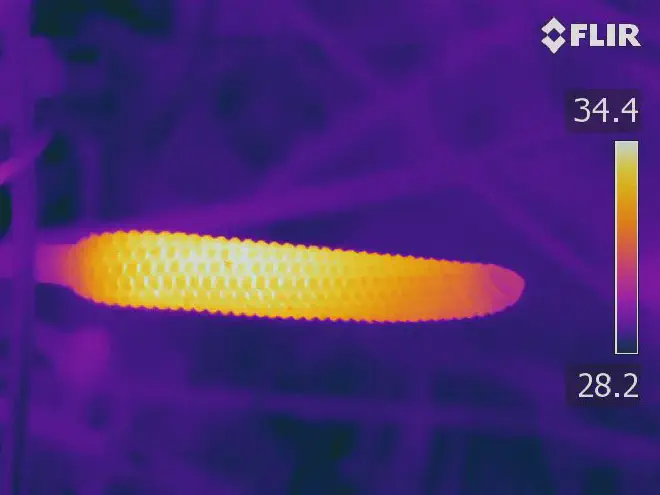
Plants have evolved a remarkable array of strategies to attract pollinators, including not only color and scent, but also the production of heat. Thermogenic plants generate heat through intense cellular respiration. It’s thought that in some cases, this heat, via infrared radiation, may serve as a direct signal to pollinating insects. However, the ecological and functional role of plant thermogenesis remains speculative.
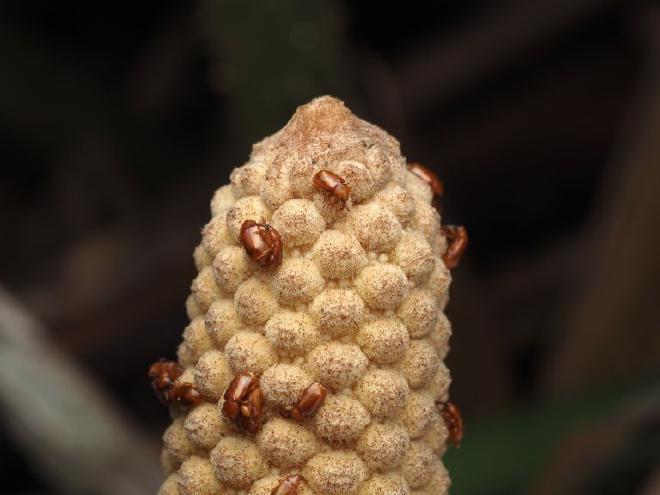
Cycads, the oldest lineage of animal-pollinated seed plants, account for over half of all thermogenic species and rely on specialized beetle pollinators. Fossil evidence indicates that cycad-beetle interactions date back at least 200 million years, making them an ideal system to investigate whether the production of thermal infrared radiation functions as a sensory cue for pollinators and to explore early plant-pollinator evolution.
Valencia-Montoya et al. found that mitochondrial adaptation and circadian genes drive rhythmic heat production in the plant’s reproductive structures, causing cycads to emit a single daily burst of heat production starting in the afternoon and peaking in the early evening. This infrared radiation alone is sufficient to attract beetle pollinators.

Evolutionary comparisons further show that infrared signaling predates the rise of widespread color-based pollination cues. “Infrared is most easily detectable at night, largely limiting cycads to pollination by night-flying beetles,” wrote Beverly Glover and Alex Webb in a related Perspective.
Citation #
- The study Infrared radiation is an ancient pollination signal was published on Science journal. Authors: Wendy A. Valencia-Montoya, Marjorie A. Liénard, Neil Rosser, Michael Calonje, Shayla Salzman, Cheng-Chia Tsai, Nanfang Yu, John R. Carlson, Rodrigo Cogni, Naomi E. Pierce, and Nicholas W. Bellono.
Funding #
-
This research was funded in part by the USA National Institutes of Health.
-
You may read the article First, male gets heated up, then female, and then, you know, written by Kermit Pattison and published on The Harvard Gazette
Thanks #
- Many thanks to (all) the researchers, Kermit Pattison and The Harvard Gazette.
Contact [Notaspampeanas](mailto: notaspampeanas@gmail.com)