


While wheat advances towards a record harvest, the first analyses from INTA warn about the quality of the grains. In Córdoba, the sampling carried out by the Wheat Group and the Laboratory of Industrial Quality and Added Value of Cereals and Oilseeds of INTA Marcos Juárez detected protein and gluten levels below commercial values.
Leticia Mir, head of the Quality Laboratory of INTA Marcos Juárez, explained that “this result is a direct consequence of the high yields, since when production increases, the protein tends to dilute if fertilization does not support the greater demand of the crop”.
Dionisio Gómez —a wheat improvement specialist from INTA and head of the national wheat trials network of INASE— pointed out that the producer usually tends to fertilize based on the production ceilings of each area and the climate. “This year, in Córdoba, it rained four times more than normal: rains were recorded in June, July, and August,” he indicated, and added that: “the wheat yielded in all environments, even in the most marginal ones.”
“For this reason, it is expected to find plots with that level of productivity,” Gómez pointed out, and emphasized that, beyond this particular year, it is important to incorporate a second fertilization as part of the management. “If the wheat doesn’t take advantage of it, the next crop will,” he underlined.
Quality results in 100 recollections #
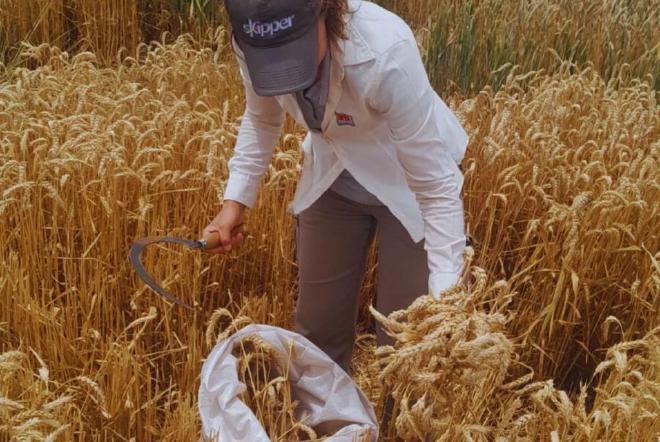
The Quality Laboratory of INTA Marcos Juárez is conducting a survey in 100 storage plants located in Córdoba, southern Santa Fe, northern Buenos Aires, and some areas of Entre Ríos, with the aim of collecting representative samples of the grain entering the market. This is a work that the institution has been carrying out for four decades.
So far, 65 grain storage facilities in the central region of the country have been surveyed. In the wheat-growing subzone of Pampa Mesopotámica on Entre Ríos— the survey included 17 grain storage facilities.
Mir reported that the average protein value was 9% and the hectoliter weight was 78.1 kg/hl, corresponding to a commercialization grade of 2. Protein levels showed variability with averages ranging between 9.7% and 7.6%. The behavior of wet gluten also showed difficulties. “Of the 17 collections, in eight it failed to form gluten and in the rest the average was 17.9%,” she said.
In the northern undulating Pampas subregion, which extends from the center to the south of the departments of Santa Fe, the survey of stockpiles showed an average of 9.6% protein and a hectoliter weight of 79.2 kg/hl, corresponding to grade 1 for commercialization. In some stockpiles, values above 81 kg/hl were recorded. Wet gluten averaged 19.7% and, except in two cases, all samples managed to form gluten.
Similar results were observed in the North Subhumid Pampa subregion, which includes stockpiles from the departments of Marcos Juárez, General San Martín, and Unión, in Córdoba. There, the average protein was also 9.6%, with a hectoliter weight close to 79 kg/hl and gluten corresponding to that protein level, at 19.5%.
In the northern semi-arid Pampas region —with surveys in Tercero Arriba and Río Segundo— the values remained within the same trend: average protein of 9.5%, hectoliter weight of 78.9 kg/hl, and a higher wet gluten, around 21.9%.
Also, Mir pointed out that this behavior is repeated throughout the central region of the country. “The survey of stockpiles and cooperatives is showing high yields accompanied by very low protein levels,” she explained. On average, the values are around 9.6%, with a variability ranging from 7.8% to 10.3%, and very few cases exceeding 10%.
However, the hectoliter weight,** in this campaign, does not appear as a limitation: the values are located between grade 1 and 3, with a predominance of samples within grade 2 and higher.** “The critical parameters for commercialization are protein and gluten. Even in lots where refertilization schemes were applied, the observed yield levels were so high that the drop in protein could not be stopped,” indicated Mir.
It should be stated that 11% is the threshold from which the commercial discounts applied by mills on Argentine bread wheat begin. The discounts are cumulative and are calculated for each point or fraction below that value: 2% between 11 and 10%, an additional 3% between 10 and 9%, and another 4% between 9 and 8%.
Laboratory analysis #
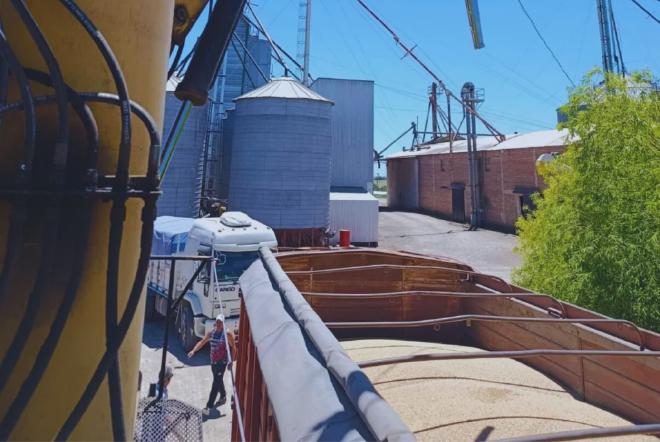
As a recommendation, he pointed out the importance of carrying out quality controls in a reference laboratory. “It is important that producers do the analyses in a laboratory, such as INTA or another entity,” Gómez indicated.
A second recommendation focused on expanding the analysis beyond protein. Some varieties of wheat show, even with low protein values, a high gluten content that improves the baking aptitude of the grain. “There are certain varieties that, despite having low protein, present superior gluten and that means they maintain their baking quality,” Gómez pointed out.
Final report #
In recent years, the survey by INTA Marcos Juárez was strengthened through an agreement reached with the Córdoba Stock Exchange, which allows monitoring all wheat-producing departments in the province. The Stock Exchange conducts the commercial analysis, while the INTA laboratory is in charge of evaluating the industrial quality. The final report is presented in February, at the National Wheat Festival celebrated in Leones with representatives from the entire value chain.
All this activity is part of the Regional Agriculture Project that INTA develops in Córdoba, with the objective of strengthening the competitiveness of the wheat chain in the region.
Contact [Notaspampeanas](mailto: notaspampeanas@gmail.com)